








Arduino vs ESP32: Which Board is Better for Your Projects in 2026?

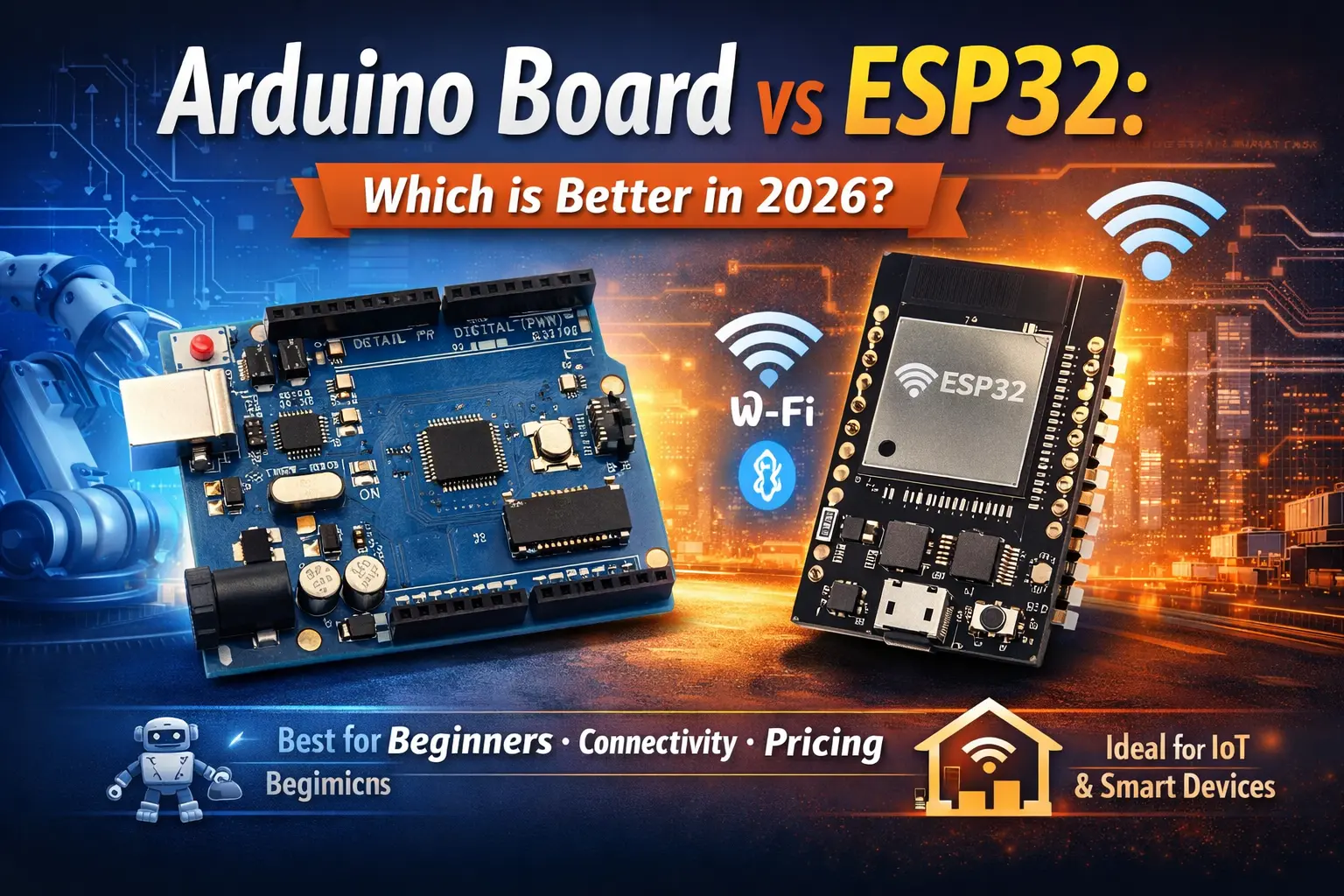
If you are starting your journey in electronics or planning your next robotics or IoT project, one common question always comes up — Arduino vs ESP32, which one should you choose?
Both platforms are widely used in India for learning embedded systems, building automation projects, and developing smart devices. The arduino board has been the go-to choice for beginners for years due to its simplicity and strong community support. On the other hand, the esp32 module, developed by Espressif Systems, offers powerful features like built-in WiFi and Bluetooth, making it ideal for modern IoT applications.
Understanding the difference between these boards is important because your choice directly affects project performance, cost, and complexity. Whether you’re working on a college project, a robotics prototype, or a home automation system, selecting the right arduino development board or ESP32 can save time and improve results.
What is an Arduino Board?
To understand the comparison, let’s first answer a basic question: what is arduino board?
An Arduino is a microcontroller-based development platform designed to simplify electronics programming. It consists of a hardware board and an easy-to-use software environment (Arduino IDE).
The arduino controller is typically based on microcontrollers like ATmega328P or ATmega2560. These chips act as the brain of your project, controlling sensors, motors, and other components.
Types of Arduino Boards
There are several types of arduino boards, each suited for different applications:
- Arduino Uno (most popular for beginners)
- Arduino Mega 2560 (more pins and memory)
- Arduino Leonardo (USB-based control projects)
- LilyPad Arduino (wearable electronics)
When exploring types of arduino uno, you’ll often find compatible versions available at affordable pricing in India. The arduino uno board price typically ranges from ₹300 to ₹800 depending on quality and chipset.
What is ESP32 and How is it Different?
The esp32 module, also known as espressif esp32, is a powerful microcontroller developed by Espressif Systems. Unlike traditional Arduino boards, ESP32 is designed for connectivity-focused applications.
Key Features of ESP32
- Built-in WiFi and Bluetooth
- Dual-core processor (faster than Arduino)
- More GPIO pins
- Lower power consumption modes
- Advanced peripherals like touch sensors
The esp32 espressif platform is widely used in IoT, smart home systems, and wireless communication projects.
In terms of affordability, the esp32 module price in India is quite reasonable, typically ranging between ₹250 to ₹600, making it a strong competitor to Arduino boards.
Arduino vs ESP32: Key Differences
Let’s compare both platforms based on important engineering parameters:
1. Processing Power
The processor in arduino (like ATmega328P) runs at around 16 MHz.
ESP32, on the other hand, runs up to 240 MHz with dual-core processing.
Winner: ESP32
2. Connectivity
Arduino boards usually require external modules for WiFi or Bluetooth.
ESP32 comes with built-in connectivity.
Winner: ESP32
3. Ease of Use
Arduino is beginner-friendly with simple coding and a massive community.
ESP32 has a slightly steeper learning curve.
Winner: Arduino
4. Power Consumption
ESP32 supports deep sleep modes, making it efficient for battery-powered devices.
Winner: ESP32
5. Cost
Both are affordable, but Arduino-compatible boards are often cheaper for beginners.
Tie (depends on project)
Technical Explanation (Engineering Perspective)
From an engineering standpoint, both Arduino and ESP32 are microcontroller-based development boards, but their architectures differ significantly.
An Arduino board typically uses an 8-bit microcontroller, which is sufficient for:
- Reading sensor data (temperature, humidity, IR)
- Controlling actuators (LEDs, relays, motors)
- Basic automation logic
In a typical Arduino setup, you will work with:
- Sensors (like ultrasonic, IR, DHT11)
- Resistors for current limiting
- Motor drivers (L298N, L293D)
- Breadboards and jumper wires
ESP32, however, uses a 32-bit microcontroller with integrated wireless capabilities. It supports:
- Real-time data transmission
- Cloud communication
- Advanced protocols like MQTT, HTTP
This makes ESP32 ideal for connected systems where data exchange is critical.
Practical Use Cases
Arduino Use Cases
- Line-following robots
- Obstacle avoidance robots
- Basic automation systems
- Educational STEM kits
- Motor control projects
ESP32 Use Cases
- IoT-based home automation
- Smart agriculture systems
- Wireless sensor networks
- Voice-controlled devices
- Drone communication systems
For example, combining ESP32 with a voice module like AI Thinker VC-02 allows you to build smart voice-controlled devices.
Explore Development Boards at StemVolt
If you’re planning to start your project, you can explore high-quality boards and modules:
Check out:
- Arduino Leonardo R3 Compatible Board
- Arduino LilyPad Wearable Board
- Arduino Mega 2560 Compatible Board
- 30-Pin ESP32 Development Board (WiFi + Bluetooth)
- AI Thinker VC-02 Voice Recognition Module
👉 Explore more Arduino options here:
https://stemvolt.in/product-category/development-boards/arduino-compatible-boards/
These boards are suitable for students, hobbyists, and professionals looking for reliable components in India.
Beginner Tips for Choosing Between Arduino and ESP32
- Start with Arduino if you’re new to electronics and programming.
- Choose ESP32 if your project requires WiFi or Bluetooth.
- Understand your project requirements before buying hardware.
- Practice with simple sensor-based projects first.
- Use proper power supply and avoid overloading GPIO pins.
- Refer to datasheets for both Arduino and ESP32 modules.
Conclusion
Both Arduino and ESP32 are powerful platforms, but they serve slightly different purposes. The arduino board remains one of the best choices for beginners and educational projects due to its simplicity and strong ecosystem. It is ideal for understanding the fundamentals of embedded systems.
On the other hand, the esp32 module from Espressif Systems brings modern capabilities like wireless connectivity and high processing power, making it perfect for IoT and advanced applications.
In 2026, the “better” board depends entirely on your project needs. If you are learning, prototyping, or working on simple robotics, Arduino is a great starting point. If you are building connected systems or smart devices, ESP32 is the smarter choice.
For Indian students and makers, having access to both platforms opens up endless possibilities in electronics and innovation.