














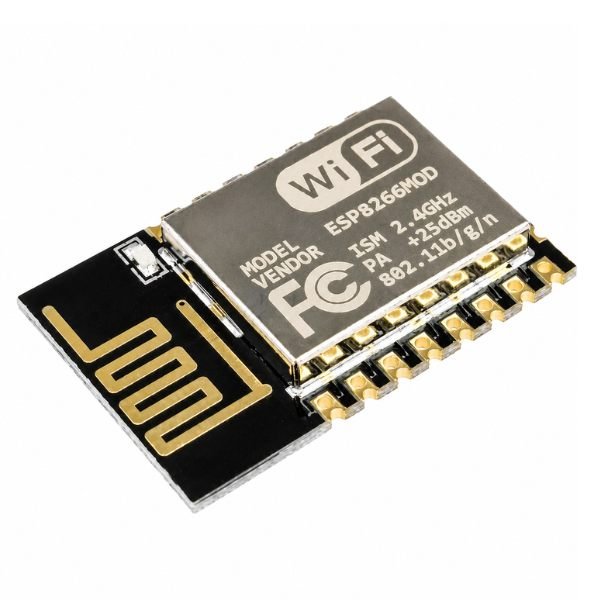
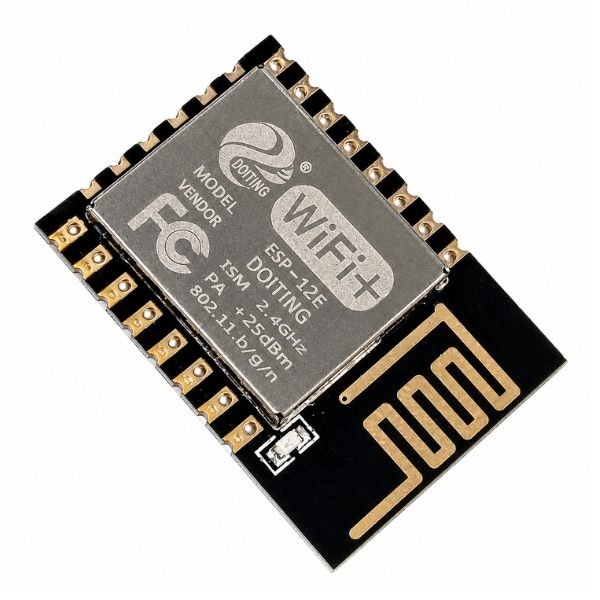
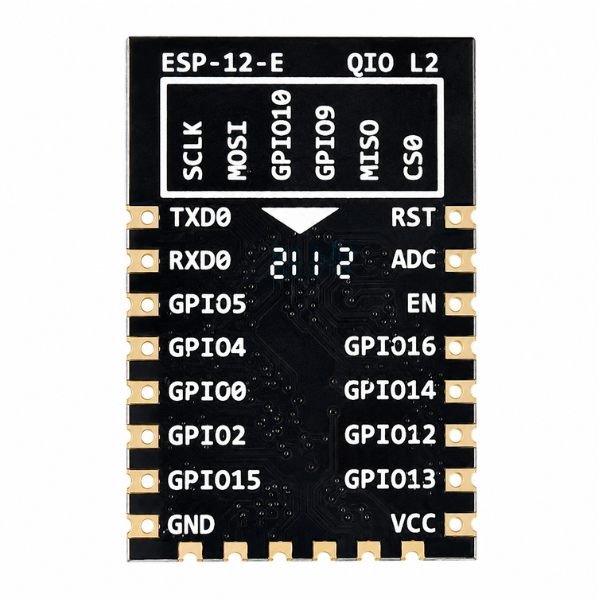



The ESP8266 WiFi Transceiver Module is a compact board built around the ESP8266 chip — a full WiFi SoC (System on Chip) with a built-in processor and TCP/IP stack. The esp8266 wifi module supports 802.11 b/g/n wireless standard on the 2.4GHz band, covering the frequency range 2400MHz to 2483.5MHz. It communicates with a host microcontroller over UART (a two-wire serial interface) or can run firmware entirely standalone without a separate processor. GPIO (General Purpose Input/Output) pins let you connect sensors and control outputs directly from the chip.
The esp 12e module variant uses a metal shielding can over the RF circuitry, which reduces interference from nearby components on your PCB. A non-obvious fact — the ESP8266 has a single ADC (Analogue to Digital Converter) pin, but it only reads up to 1V by default. Most breakout boards include a voltage divider to bring the range up to 3.3V. The honest trade-off is power consumption. Deep sleep reduces current dramatically, but active WiFi transmission pulls 80mA average, which drains small batteries quickly during continuous operation.
The esp8266 wifi module pins support HSPI, I2C, I2S, and PWM alongside standard UART, giving a wide range of peripheral options. Engineers building IoT sensor nodes, students learning MQTT-based projects, and makers prototyping home automation systems use this module regularly. Load firmware using the Arduino IDE with the ESP8266 board package installed — or use MicroPython for scripted operation. To start, connect VCC to 3.3V, GND to ground, VCC, then flash over serial. StemVolt ensures fast, reliable delivery of products across India with trusted service.
Related Products:
-
Explore the ESP boards for build creative iot projects
Features:
- 802.11 b/g/n WiFi at 2.4GHz for standard router and AP connectivity
- UART HSPI I2C I2S GPIO PWM all available on castellated pads
- -40°C to 125°C operating range suits outdoor industrial sensor deployment
- 3.3V 80mA compact SMD module for PCB-level WiFi integration
- Onboard PCB trace antenna eliminates need for external antenna component
Technical specifications:
| Specification | Details |
|---|---|
| Module | WiFi Module (ESP-12E) |
| Based On | ESP8266 |
| Wireless Standard | 802.11 b/g/n |
| Frequency | 2.4 GHz – 2.5 GHz |
| Data Interface | UART, HSPI, I2C, I2S, GPIO, PWM |
| Operating Voltage | 3.0 V – 3.6 V (3.3 V Recommended) |
| Working Current | 80 mA (Average) |
| Operating Temperature | -40°C to 125°C |
Applications:
- ESP12E Module used for custom PCB WiFi IoT sensor node build
- Indian IoT product lab uses esp8266 wifi module for smart board design
- AT command WiFi bridge uses esp 12e module for serial WiFi gateway
- Industrial sensor node uses esp8266 module for -40°C outdoor deployment
- ESP-NOW mesh uses Esp12E WiFi Transceiver Module for multi-node network
Package includes:
- 1 x ESP8266 WiFi Transceiver Module




Dev Bhatnagar –
Fully satisfied purchase
Kian Mathur –
Exactly as described
Siya Singhal –
This module provides reliable wireless network connectivity and works perfectly for engineering projects, automation systems, and IoT applications.