













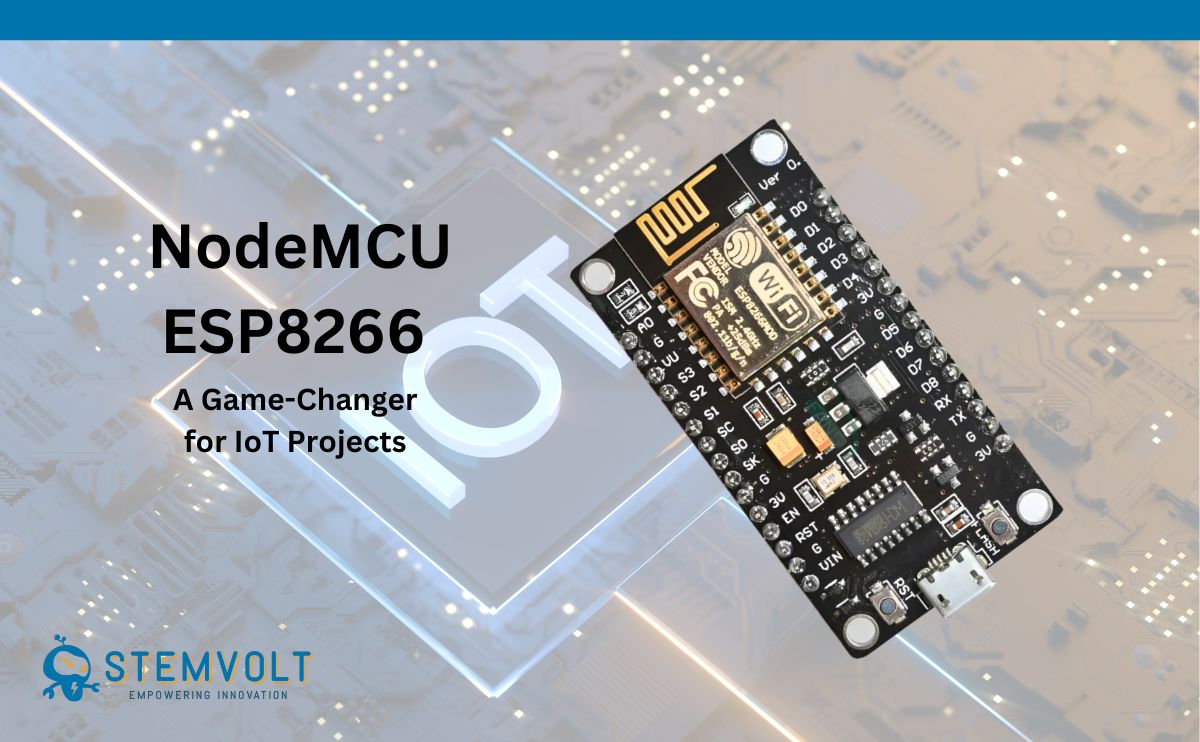
NodeMCU ESP8266

Introduction
If you have ever dreamt of controlling your home lights from across the world or monitoring your garden’s soil moisture on your smartphone, you have likely encountered the esp8266 esp 01 wifi module. This tiny, blue-colored board revolutionized the electronics industry when it was first released, offering a complete WiFi stack at a price point that was previously unthinkable. For students and makers in India, it became the gateway to the Internet of Things (IoT).
The significance of the ESP8266 lies in its ability to give “sight” and “speech” to standalone hardware. Before this module, adding internet connectivity to a project required expensive shields and bulky setups. Today, whether you are a hobbyist building a simple weather station or an engineer designing a smart energy meter, the esp8266 wifi module esp 01 provides a compact and reliable solution. At StemVolt, we see this module as the fundamental building block for any modern STEM learning curriculum or engineering prototype.
What is the ESP8266 ESP-01 WiFi Module?
The ESP8266 is not just a WiFi chip; it is a self-contained System-on-Chip (SoC) with an integrated TCP/IP protocol stack. The esp 01 wifi module is the most basic and compact version of the ESP8266 family. It features a small PCB antenna, a few GPIO pins, and a standard 8-pin header.
While it looks simple, it contains a powerful 32-bit RISC CPU. This means it can either be used as a WiFi adapter for an Arduino or run as a standalone microcontroller itself. Its compact size makes it perfect for “hidden” IoT applications where space is a premium. In the Indian market, its popularity stems from its massive community support and compatibility with popular platforms like the Arduino IDE and MicroPython.
How it Works: The Bridge Between Hardware and Internet
To understand how an esp wifi module operates, you have to think of it as a translator. It takes data from sensors or switches and translates it into data packets that can travel over your home WiFi router to the cloud.
The module operates on a standard 3.3V power supply. It uses Serial communication (UART) to talk to other devices. When you send “AT Commands” to the module, it performs specific tasks like searching for nearby networks, connecting to an Access Point, or sending an HTTP request to a website. More advanced users often “flash” custom firmware onto the chip, allowing the esp8266 wifi module esp 01 to handle logic internally without needing an external Arduino.
Key Benefits in Modern Electronics Projects
The esp8266 esp 01 wifi module offers several advantages that make it a favorite for Indian engineering students:
Cost-Effectiveness: It provides professional-grade wireless connectivity at a fraction of the cost of traditional WiFi shields.
Ultra-Low Power Modes: It can be programmed to go into “Deep Sleep,” waking up only to send data and then sleeping again, which is perfect for battery-operated sensors.
Standalone Capability: For simple tasks like turning a relay on/off, you don’t need an extra microcontroller; the ESP-01 can do it all.
Massive Integration: It works seamlessly with IoT platforms like Blynk, Adafruit IO, and ThingSpeak, allowing you to create dashboards in minutes.
Technical Explanation for Engineers
From an engineering perspective, the ESP8266 is a high-performance wireless SoC. It includes a built-in frequency synthesizer, power management units, and antenna switches.
When building a system, you will typically interface the module with:
Microcontrollers: Use it with an Arduino Uno or Nano via the RX/TX pins.
Development Boards: While the ESP-01 is great for small tasks, many engineers prefer the ESP12E ESP8266 WiFi Transceiver for projects requiring more GPIO pins and memory.
Sensors: Connecting temperature or motion sensors directly to its input pins.
Resistors: Crucial for “Pull-up” and “Pull-down” configurations to ensure the chip boots in the correct mode (Flash vs. Run).
Motor Drivers: For robotics projects where you need to control a rover over a web interface.
If you find the ESP8266 power-hungry for your specific AI or Bluetooth needs, you might consider stepping up to the 30-Pin ESP-32 Development Board, which adds Bluetooth and dual-core processing to the mix.
Practical Use Cases and IoT Experiments
Smart Lighting: Controlling a room light via a web dashboard or voice assistant.
Remote Weather Monitoring: Sending humidity and temperature data from a rooftop sensor to a cloud database.
Industrial Automation: Monitoring machine uptime and status remotely in a factory setting.
STEM Learning: Teaching students how networking protocols like TCP/IP and HTTP work in a physical environment.
Agriculture Tech: Automated irrigation systems that trigger based on weather forecasts pulled from the internet.
Essential Resources at StemVolt
To get the most out of your wireless projects, you need the right hardware. Explore our curated collections for high-quality boards and modules:
Check out: ESP12E ESP8266 WiFi Transceiver Module
Check out: 30-Pin ESP-32 Development Board (Type-C)
Explore more: Full ESP Boards Category
Wireless Connectivity: ESP WiFi Modules Collection
Expert Beginner Tips for ESP8266 Success
Never Use 5V: The esp 01 wifi module is strictly a 3.3V device. Connecting it to a 5V pin on an Arduino will burn the chip instantly. Use a logic level shifter or a dedicated 3.3V regulator.
Current Matters: WiFi transmission requires high current spikes (up to 200mA). The 3.3V pin on an Arduino Uno is often too weak. Use an external power supply for stability.
Check the Baud Rate: Most new modules come with a default baud rate of 115200. If you see “garbage” text in your serial monitor, try changing the baud rate setting.
Use an Adapter: Programming the ESP-01 on a breadboard can be messy because of its pin layout. Using a dedicated USB-to-ESP-01 adapter will save you hours of wiring frustration.
Update Firmware: If your module isn’t responding to AT commands, it might have old or corrupted firmware. Re-flashing it with the latest Espressif firmware often fixes connection issues.
Conclusion
The esp8266 esp 01 wifi module remains one of the most powerful tools in a maker’s arsenal. Its ability to turn a simple circuit into a globally connected device is what makes IoT so exciting. For students and engineers in India, the ESP8266 represents an opportunity to build world-class technology on a student-friendly budget.
Whether you are just starting with your first “Hello World” over WiFi or designing a complex automation system, the ESP8266 provides the flexibility and reliability you need. At StemVolt, we are dedicated to supporting your journey by providing the best esp wifi module options and technical guidance. Connectivity is the future—and with the ESP8266, that future is right in the palm of your hand.