












HC-SR04 Ultrasonic Sensor

Introduction
In the world of robotics and automation, “sight” isn’t always about cameras. Often, it is about measuring the distance between a machine and its surroundings. This is where the ultrasonic sensor comes into play. The HC-SR04 is arguably the most popular sensor among Indian engineering students and makers because it provides an affordable, reliable, and easy-to-use way to detect obstacles.
Whether you are building an obstacle-avoiding robot, a digital measuring tape, or a touchless liquid level monitor, understanding this ultrasonic distance sensor is a fundamental skill. It bridges the gap between raw physics—specifically sound waves—and digital logic. In this guide, we will explore why the HC-SR04 is a staple in every electronics lab, how it maintains an impressive ultrasonic sensor range despite its small size, and why sourcing it from StemVolt ensures you get the right quality for your high-stakes college projects.
What is the HC-SR04 Ultrasonic Sensor?
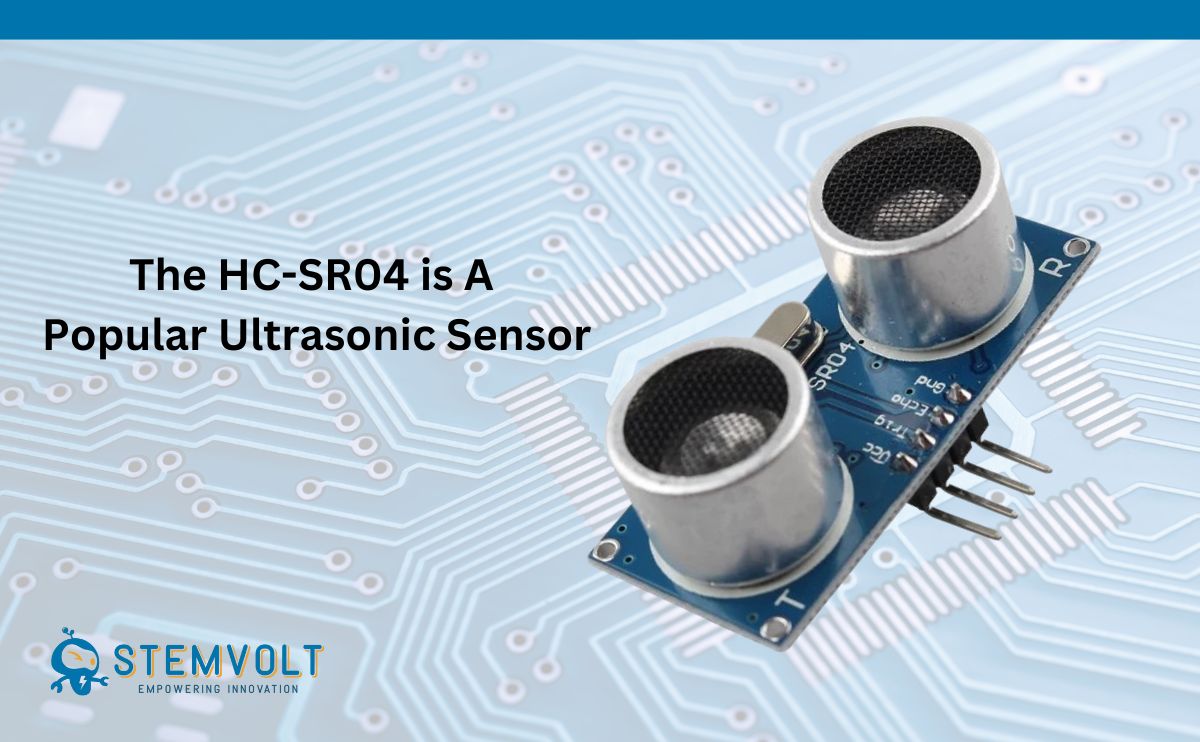
The HC-SR04 is an electronic module that uses sound waves to measure the distance to an object. It is often referred to as the “eyes” of a basic robot. Looking at the module, you will notice two metallic cylinders that look like eyes; these are actually ultrasonic transducers. One acts as a transmitter (Trigger) and the other as a receiver (Echo).
Unlike an ultrasonic atomiser which uses high-frequency vibrations to turn liquids into mist, the HC-SR04 uses these vibrations to calculate “time of flight.” It is designed to work primarily with microcontrollers like Arduino, Raspberry Pi, and ESP32. For developers in India, the low ultrasonic sensor price makes it a go-to component for rapid prototyping and classroom learning.
How the Ultrasonic Sensor Works: The Physics of Sound
The working principle of an ultrasonic sensor is based on “Echolocation,” the same technique used by bats and dolphins to navigate in the dark.
The Trigger: The microcontroller sends a short 10-microsecond pulse to the Trigger pin.
Sound Emission: The sensor then emits a burst of eight ultrasonic pulses at 40 kHz (sound that is too high-frequency for human ears to hear).
The Bounce: These sound waves travel through the air until they hit an object.
The Echo: After hitting an object, the waves reflect back toward the sensor.
Calculation: The Echo pin goes “HIGH” the moment the sound is sent and stays high until the reflected sound is received. By measuring the duration the Echo pin was HIGH, we can calculate the distance.
The formula used by engineers is: Distance = (Time × Speed of Sound in Air) / 2 (We divide by 2 because the sound travels to the object and back again).
Key Technical Specifications and Range
When designing a project, an engineer must respect the limitations of their components. The ultrasonic sensor range for the HC-SR04 is typically between 2cm and 400cm (4 meters). While this is sufficient for most indoor robotics, the accuracy can be affected by the surface of the object. For example, soft clothes might absorb the sound waves, leading to incorrect readings, whereas hard surfaces like walls provide excellent reflection.
The module operates at 5V DC, making it perfectly compatible with most development boards. It has a sensing angle of roughly 15 degrees, meaning it “sees” in a cone shape. Understanding this cone is vital when mounting the sensor on a robot chassis to ensure it doesn’t accidentally detect the robot’s own wheels or frame.
Technical Integration with Electronics
Integrating an ultrasonic distance sensor into a circuit requires more than just the module. Here is how a senior engineer looks at the setup:
Microcontrollers: The Arduino Uno or Nano is the most common “brain” used to time the Echo pulse.
Power Stability: Ultrasonic sensors can be sensitive to power fluctuations. Using a decoupling capacitor or a stable power rail from your development boards is recommended.
Signal Conversion: If you are using a 3.3V microcontroller like an ESP32, you might need a voltage divider using resistors to ensure the 5V Echo signal doesn’t damage your controller’s input pins.
Visual Feedback: For projects like a digital scale, pairing the sensor with a Digital Display Module for HC-SR04 makes the data human-readable without needing a laptop.
Practical Use Cases for Students and Engineers
Obstacle Avoiding Robots: This is the most common use. The sensor detects a wall, and the Arduino tells the motor drivers to reverse or turn.
Water Level Indicator: Mounted at the top of a tank, the sensor measures the distance to the water surface. As the water rises, the distance decreases.
Touchless Doorbell/Switch: Detecting a hand within a specific range to trigger an action without physical contact.
Parking Sensors: DIY versions of the sensors found in modern cars to help drivers park without hitting obstacles.
IoT Smart Dustbins: Detecting when a bin is full and sending an alert over Wi-Fi.
Get Your Gear at StemVolt
Quality matters when it comes to sensors. A low-quality sensor will give “noisy” data, making your robot jittery. At StemVolt, we test our modules to ensure they meet the standard ultrasonic sensor range and accuracy.
Check out: HC-SR04 Ultrasonic Distance Sensor
Check out: Digital Display Module for HC-SR04
Explore more: All Sensors Category
Specific Needs: IR, Ultrasonic, and Proximity Sensors
Beginner Tips for Ultrasonic Success
Watch the Voltage: While the HC-SR04 is a 5V device, many modern boards are 3.3V. Always check compatibility before plugging it in.
Avoid “Ghost” Reflections: If you place the sensor too close to the floor, it might detect the ground instead of an obstacle in front of it. Mount it at least 2-3 inches high.
Software Filters: In your code, take 5 readings and calculate the average. This “Median Filter” helps ignore random spikes in data (noise).
Object Material Matters: If you are testing your sensor and it isn’t working, try pointing it at a flat, hard wall. Round or soft objects are much harder for the sensor to “see.”
Timing is Everything: Give the sensor a small delay (about 50ms-100ms) between consecutive readings to allow the previous sound waves to dissipate.
Conclusion
The ultrasonic sensor is a remarkable piece of engineering that simplifies a complex task: measuring distance without touch. For the Indian maker community, the HC-SR04 remains a top choice because of its balanced ultrasonic sensor price and impressive performance. From simple STEM kits to advanced engineering prototypes, this sensor teaches us the importance of precision and the physics of wave propagation.
As you continue your journey in electronics, remember that sensors are the bridge between your code and the real world. By mastering the HC-SR04, you are laying the groundwork for more advanced perception systems like LiDAR and Radar. At StemVolt, we are here to provide you with the high-quality parts and knowledge you need to build something extraordinary.