














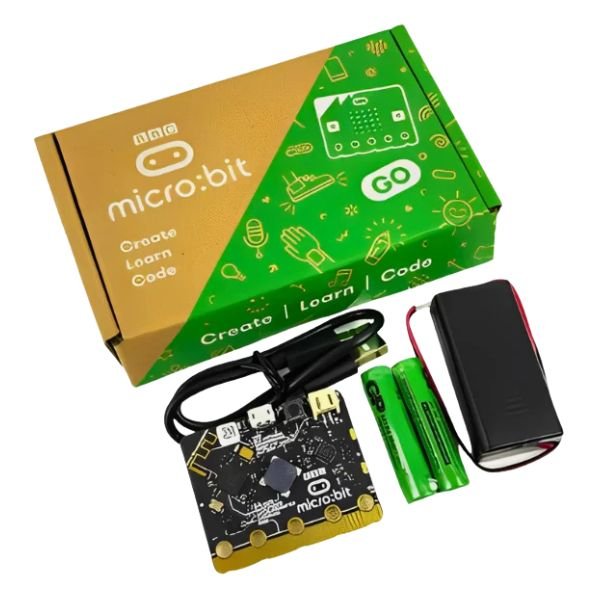
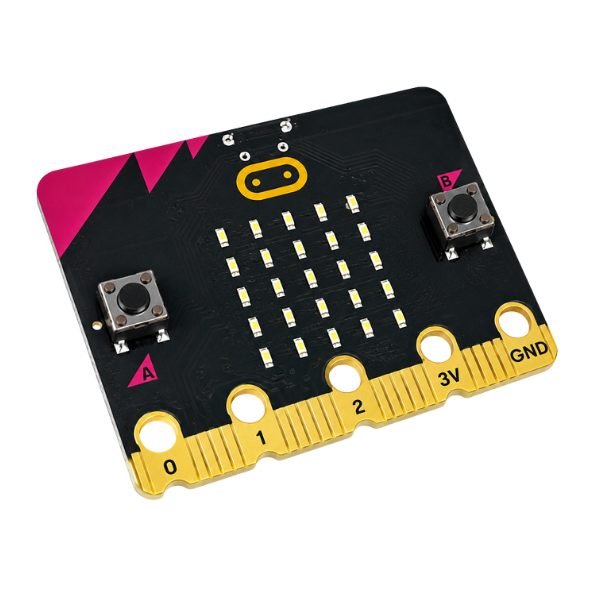
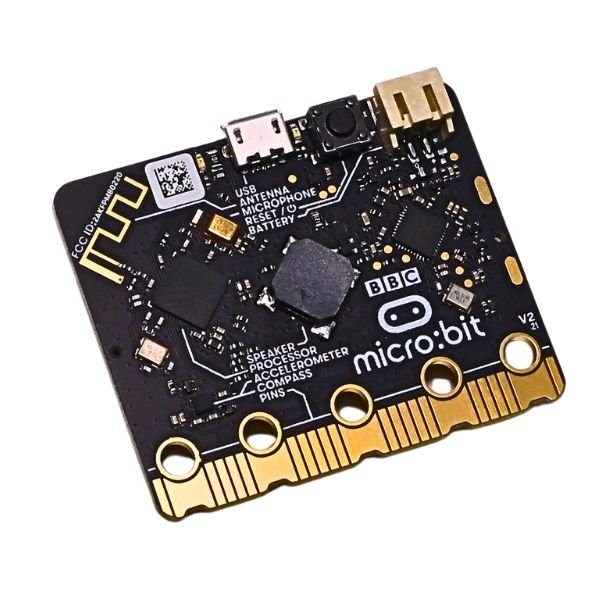
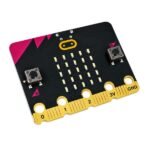
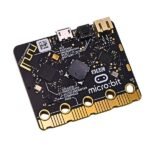



The BBC MicroBit V2.2 runs a 32-bit ARM Cortex-M4 processor with onboard sensors, a 5×5 LED matrix, and wireless connectivity built directly onto the board. With microbit make code, students write and flash programs in a browser-based block editor without installing any software. The 25 programmable LEDs display sensor readings, scrolling text, and custom animations in real time. Motion detection, magnetometer data, and temperature readings all come from sensors already on the board — no breadboard required for basic projects.
A non-obvious detail about the BBC MicroBit V2.2 is that the logo on the front acts as a capacitive touch input. It reads touch events independently of the two physical buttons, giving three distinct input sources on a board this small. The built-in microphone and speaker are new to V2, and they work well for sound-reactive led demos and basic audio feedback. The honest limitation is storage — the Cortex-M4 has limited flash memory, so large Python programs with many libraries hit size constraints faster than more expensive development boards.
The microbit python environment, MakeCode block editor, and the JavaScript text editor all target this board directly. Primary school students, secondary school STEM classrooms, coding clubs, and hobbyists building first IoT prototypes all use it regularly. The board connects over USB for flashing and serial monitoring. Pick one up at StemVolt for fast delivery across India.
Related Product:
-
Explore the Raspberry Pi 4 Model B – 2GB RAM Board
Features:
- ARM Cortex-M4 processor runs MakeCode and Python firmware at full 32-bit speed.
- A 5×5 LED grid displays sensor values, animations, and scrolling text output clearly.
- Onboard magnetometer and motion sensor measure tilt, compass heading, and acceleration directly.
- 2.4GHz micro:bit radio pairs two boards for wireless messaging without any external module.
- BBC Micro:Bit V2.2 microcontroller board includes a rear LED power indicator for status confirmation.
Technical specifications:
| Specification | Details |
|---|---|
| Processor | 32-bit ARM Cortex-M4 |
| Clock Speed | 64 MHz |
| Flash Memory | 512 KB |
| RAM | 128 KB |
| Display | 25 Programmable LEDs (5×5 Grid) |
| Buttons | 2 Programmable Buttons (A & B) |
| Touch Sensor | Logo Capacitive Input |
| Microphone & Speaker | Yes — Onboard |
| Sensors | Motion, Magnetometer, Temperature |
| Connectivity | 2.4 GHz Radio + Bluetooth |
| Pins | 25 Edge Connector Pins |
| Power Indicator | Rear-mounted LED |
Applications:
- Students use BBC MicroBit V2.2 to build weather stations logging temperature and motion data wirelessly
- Microbit make code projects display real-time sensor graphs on the 5×5 LED matrix in classrooms
- Microbit python scripts control servo motors and LED strips through the 25 edge connector pins
- Teachers run peer-to-peer radio communication demos using two bbc microbit boards in one session
- Engineers prototype compact Bluetooth sensor nodes using the onboard BLE and magnetometer together
Package includes:
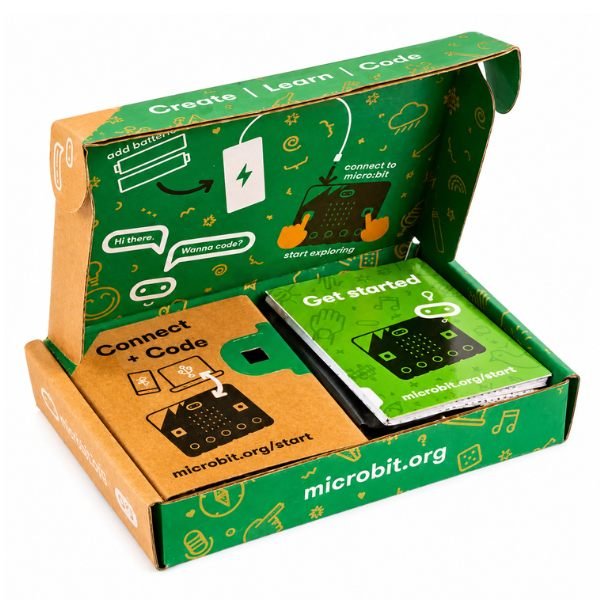
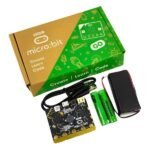
- 1 x BBC MicroBit V2.2 STEM Education Kit

Zara Shaikh –
Microphone and speaker support make this kit perfect for interactive coding and educational electronics projects
Tanya Agarwal –
Original product received
Reyansh Nair –
Excellent STEM learning kit
Myra Kulkarni –
MicroBit works smoothly with MakeCode and Python, making it ideal for STEM learning, prototyping, and final year projects
Aarush Chatterjee –
Will order again