















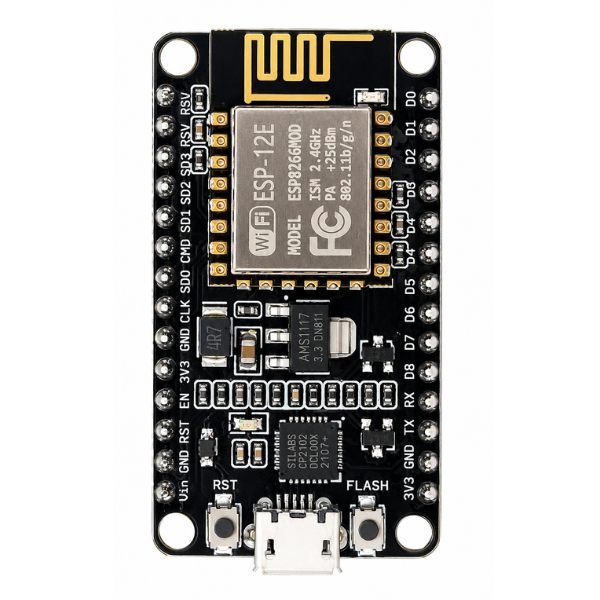
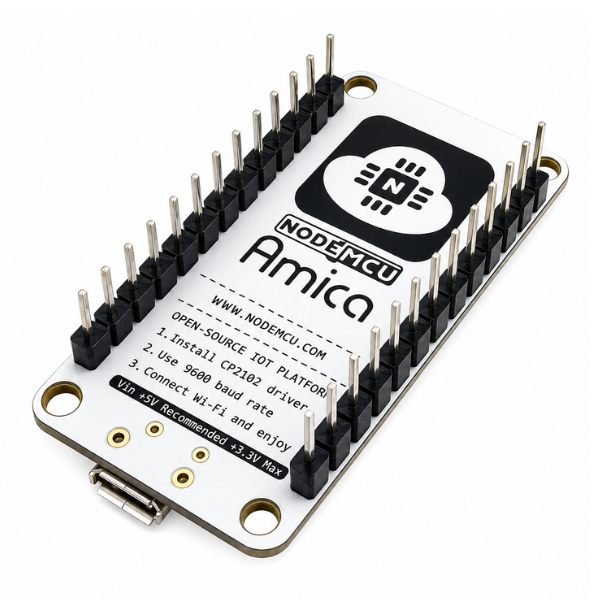
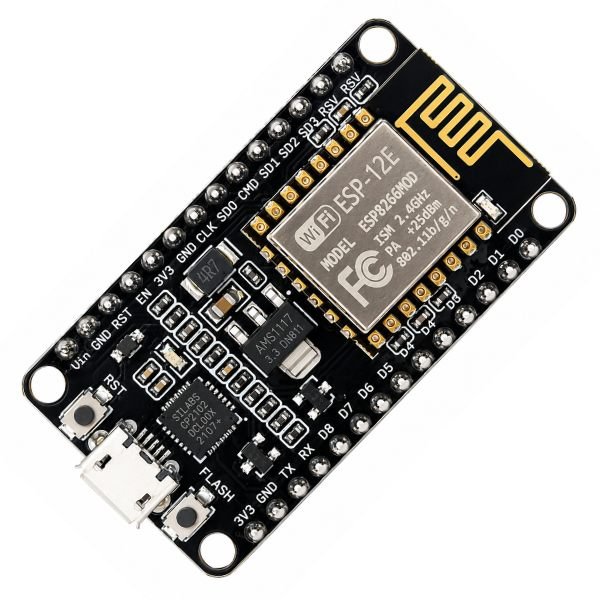
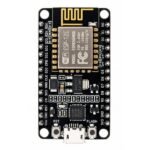
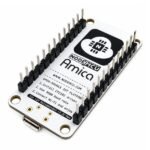
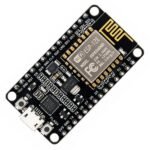



The ESP8266 Node MCU 12E AMICA is a WiFi-enabled development board built on the ESP-12E module, running the ESP8266 microcontroller at 80MHz with 4MB of flash memory and integrated 802.11 b/g/n WiFi. The nodemcu esp8266 connects to a computer via Micro USB and operates at 3.3V logic. It supports UART, SPI, and I2C protocols across its GPIO pins, and is programmable through three separate environments — Arduino IDE with ESP8266 board package, NodeMCU Lua firmware, and MicroPython — all without any hardware change.
The nodemcu esp8266 12e amica variant uses the AMICA-designed carrier board which places the CP2102 USB-to-serial chip alongside the ESP-12E module, giving reliable driver recognition on Windows, macOS, and Linux without the CH340 driver issues sometimes seen on generic NodeMCU clones. The esp8266 arduino workflow using the Arduino IDE is straightforward — install the ESP8266 board support package, select NodeMCU 1.0 as the board, and upload sketches exactly as you would for any Arduino. One practical trade-off: all GPIO pins operate at 3.3V logic. Connecting 5V signals directly will damage the ESP8266 chip — use level shifters for any 5V sensor or peripheral integration.
The non-obvious advantage of the ESP8266 12E module over earlier ESP-01 modules is the significantly larger number of exposed GPIO pins — the 12E exposes 11 usable GPIO pins versus just 2 on the ESP-01, making it practical for multi-sensor IoT builds without external GPIO expanders. The esp8266 board is the most widely used WiFi microcontroller board in Indian college IoT labs for home automation, sensor dashboards, and MQTT cloud projects. Available from StemVolt, this unit is suitable for engineers working on WiFi IoT applications and practical connected electronics projects.
Related Product:
-
Checkout the ESP Board for IoT applications
Features:
- 80 MHz Tensilica L106 handles WiFi stack and application logic on one chip
- 4 MB flash supports OTA updates, SPIFFS file system, and full sketch storage
- 802.11 b/g/n WiFi built in — connects to 2.4 GHz networks without extra hardware
- 3.3V logic matches modern sensors directly without level shifter circuits needed
- Breadboard-compatible PCB with labelled GPIO and onboard USB-to-serial chip included
Technical Specifications:
| Specification | Details |
|---|---|
| Microcontroller | ESP8266 |
| Clock Speed | 80 MHz |
| Flash Memory | 4 MB |
| Operating Voltage | 3.3 V |
| WiFi | 802.11 b/g/n |
| USB Interface | Micro USB |
| GPIO Pins | Multiple GPIO |
| Communication Protocols | UART, SPI, I2C |
Applications:
- Home automation builders use ESP8266 Node MCU 12E AMICA to control relays and appliances over WiFi remotely
- Students run nodemcu esp8266 weather station projects logging temperature and humidity to cloud dashboards
- Engineers build nodemcu esp8266 12e amica MQTT nodes for industrial sensor data pipeline prototyping
- ESP8266 arduino sketch controls servo motors and LEDs via web browser on local network
- Powers compact Wi-Fi door lock and RFID access systems in college projects
Package Includes:
- 1 × ESP8266 Node MCU 12E AMICA

Vivek Sharma –
Handles WiFi communication and control tasks efficiently, connects directly to routers without extra modules and interfaces easily with sensors and actuators for college projects.
Arjun Mehta –
Reliable IoT board
Sanjay Kothari –
First order satisfied