






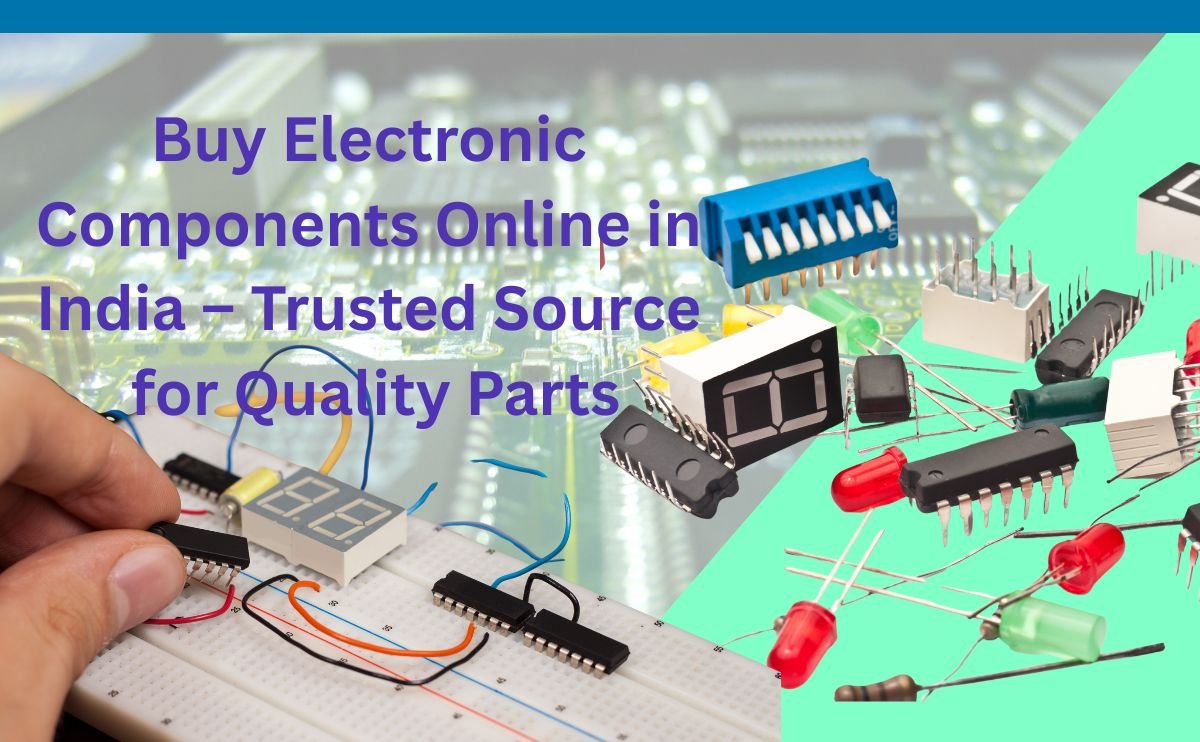
Buy Electronic Components Online in India – Trusted Source for Quality Parts

Introduction
In the journey of an electronics enthusiast, the transition from theoretical diagrams to a working prototype is a defining moment. This transition is made possible by the small yet mighty building blocks we call electronic components. Whether you are a first-year engineering student in Bangalore or a hobbyist maker in Delhi, the quality of your parts determines the reliability of your final circuit. A simple loose connection or a low-grade voltage regulator IC can be the difference between a successful demonstration and a frustrating troubleshooting session.
Understanding these components is not just about memorizing symbols; it is about knowing how they behave under different electrical conditions. In the Indian maker ecosystem, accessibility to a diverse range of parts—from a basic toggle switch to a high-efficiency 12v solar panel—has fueled a revolution in DIY automation and IoT. At StemVolt, we aim to provide not just the hardware, but the engineering context needed to use these parts effectively in your real-world projects.
The Foundation: Switches and Prototyping Boards
Every circuit needs a way to interface with the user and a place to reside. Switches like the classic toggle switch or the compact slide switch act as the primary control inputs. While a toggle switch is excellent for heavy-duty power isolation, a slide switch is often preferred for smaller, battery-operated handheld devices.
Once you have your logic ready, you need to assemble the circuit. For temporary testing, breadboards are great, but for a permanent project, a PCB board is essential. Beginners often start with a zero PCB (also known as a perfboard), where you manually solder connections using jumper wires. As your skills grow, you might look into custom pcb board price options for etched circuits. A solid prototyping foundation ensures that your components don’t move around, preventing short circuits and intermittent failures.
Visualizing Output: RGB LEDs and Indicators
Indicators are the “language” of your machine. While a standard red or green LED is common, the rgb led is a favorite among students. By using Pulse Width Modulation (PWM) from a microcontroller, a single RGB LED can produce millions of colors, making it perfect for status indicators or mood lighting projects.
For more compact designs, an smd led (Surface Mount Device) is used, though these require a bit more soldering precision. If your project needs to communicate through sound rather than light, a buzzer sensor or a small buzzer is the go-to component. These are essential in alarm systems, where the buzzer provides immediate audible feedback when a specific condition (like a door opening) is met.
Power Management and Voltage Regulation
Power is the lifeblood of electronics. However, most microcontrollers are sensitive and require a steady voltage. This is where a voltage regulator IC (like the 7805 or LM317) becomes critical. It takes a variable input and provides a clean, constant output, protecting your expensive development boards. In more complex systems, a dedicated power management IC handles multiple voltage rails simultaneously.
For green energy projects, the 12v solar panel is a staple. When building a solar charger, you can’t connect the panel directly to a battery; you need a solar panel controller and a schottky diode to prevent reverse current flow at night. The Schottky diode is preferred here over a standard diode because of its low forward voltage drop, ensuring maximum efficiency for your energy harvest.
Passive Components: Capacitors, Diodes, and Pots
No circuit is complete without passive components. When you capacitor purchase online, you are essentially buying a “storage tank” for electricity that smooths out ripples in your power supply. Similarly, the rotary potentiometer (or its smaller cousin, the trimmer potentiometer) allows you to manually adjust parameters like volume, brightness, or timing in an analog circuit.
These components work behind the scenes. For instance, a schottky diode might be used in a high-speed switching power supply, while a large electrolytic capacitor keeps your system from resetting when a motor starts up. Understanding the diode price and specifications is key to choosing a component that can handle the current requirements of your specific application without overheating.
Technical Explanation: The Signal Chain
From an engineering perspective, a circuit is a sequence of energy and information flow. Let’s look at how these components interact in a typical automated system:
-
Input: A toggle switch or a rotary potentiometer provides a user command to a microcontroller.
-
Processing: The microcontroller (like an Arduino or ESP32) reads the input and decides the output.
-
Protection: A voltage regulator IC ensures the processor stays at 5V even if the battery fluctuates.
-
Output: The processor triggers an rgb led for a visual signal or a buzzer sensor for an alert.
-
Execution: If a high-power device is involved, a transistor acts as a switch to drive the load.
In this chain, even a small 100 ohm resistor plays a vital role by limiting current to the LED, ensuring it doesn’t burn out.
Practical Use Cases for Beginners
-
Solar Path Lights: Combining a 12v solar panel, a rechargeable battery, and an LDR.
-
Intruder Alarms: Using a PIR sensor to trigger a small buzzer and a flashing rgb led.
-
Variable Power Supplies: Using a voltage regulator IC and a rotary potentiometer to create a custom lab tool.
-
Home Automation: Deploying a zero PCB based circuit to control room lights via a smartphone.
Source Quality Parts at StemVolt
Build your next project with components that last. We offer a wide range of parts tailored for the Indian engineering community:
-
Control: Explore our 10 Types Tactile Push Button Switch Kit.
-
Light: Get a pack of 5mm LED Lights for your indicators.
-
Energy: Start with a 5V 2.5W Solar Panel for small experiments.
-
Base: Buy a Single Sided Copper Clad PCB Board for etching.
-
Adjustment: Use a 100 Ohm Preset Potentiometer for fine-tuning.
-
Essentials: Stock up with 2N2222 Transistors and Electrolytic Capacitors.
Explore our Categories:
Beginner Tips for Handling Components
-
Check Polarity: Components like electrolytic capacitors, LEDs, and diodes have a specific “direction.” Connecting them backward can lead to a “magic smoke” moment.
-
Heat Management: When soldering onto a zero PCB, avoid holding the soldering iron on a component lead for more than 2-3 seconds. Excessive heat can damage delicate voltage regulator ICs.
-
Read the Datasheet: Before you capacitor purchase online, check the voltage rating. A 16V capacitor will explode if connected to a 24V rail.
-
Organize Your Bin: Keep your trimmer potentiometer and resistors in labeled boxes. It saves hours of searching when you are in the “flow” of building.
-
Test in Stages: Don’t build the whole circuit at once. Test the power section first, then the inputs, and finally the outputs.
Conclusion
Understanding electronic components is like learning the alphabet of a new language. Once you know how a toggle switch interacts with an rgb led, or how a voltage regulator IC stabilizes a 12v solar panel system, you can start “writing” your own technological stories. From the simplest buzzer sensor to complex pcb board designs, every part has a purpose.
At StemVolt, we are proud to support India’s students and engineers by being a trusted source for quality hardware. By choosing the right components and following sound engineering practices, you aren’t just making a gadget—(You are building the future technology of India). Happy soldering!