













Arduino UNO R4 Minima & R4 WiFi – Made in India, Now Available on StemVolt

The Next Evolution of the Arduino Board: Welcome to the R4 Era
For over a decade, the Arduino UNO R3 has been the undisputed king of the maker world. If you have ever asked yourself, “what is an Arduino board?” the R3 was likely the first image that popped into your mind. It was the entry point for millions of Indian students, hobbyists, and professional engineers. however, as project requirements grew more complex—requiring more memory, faster processing, and built-in connectivity—the community needed a more powerful “brain.”
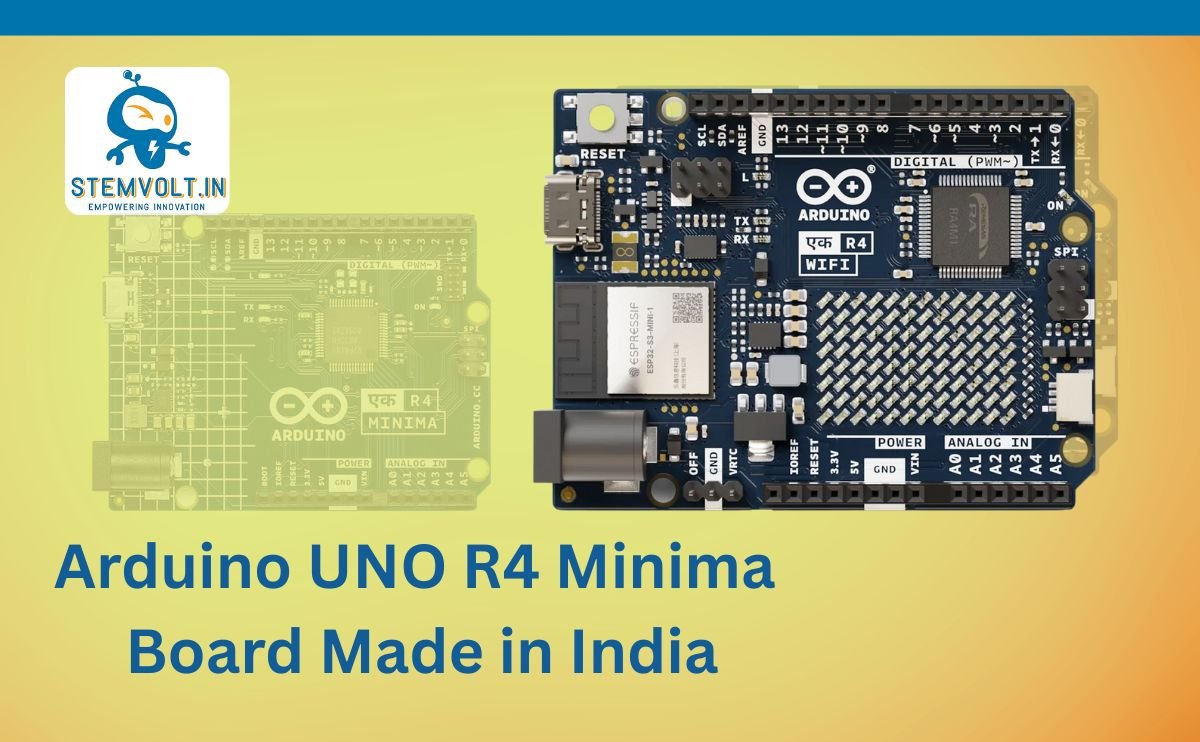
The launch of the Arduino UNO R4 Minima and the Arduino UNO R4 WiFi marks a massive leap forward. These boards aren’t just minor updates; they are a complete architectural shift from 8-bit to 32-bit processing. At StemVolt, we are excited to bring these powerful boards to the Indian market, ensuring that local makers have access to the latest global technology to build smarter robots, more efficient IoT systems, and advanced STEM projects.
What is an Arduino Board in the 32-Bit Era?
At its core, an arduino board is an open-source electronics platform based on easy-to-use hardware and software. While classic boards like the Arduino Nano relied on the AVR architecture, the new R4 series utilizes the Renesas RA4M1 microprocessor.
This change is significant. Moving to a 32-bit ARM Cortex-M4 architecture means the board can handle complex mathematical calculations and data processing much faster than its predecessors. Whether you are a student starting your first “Blink” sketch or an engineer prototyping a motor control system, the UNO R4 provides the headroom needed for modern applications without losing the simplicity that made Arduino famous.
Arduino UNO R4 Minima vs. R4 WiFi: Which One Do You Need?
The R4 comes in two distinct flavors, both available at StemVolt, designed to meet different project needs.
1. Arduino UNO R4 Minima
The Minima is the direct successor to the UNO R3. It maintains the same form factor, so your existing shields will still fit. However, internally, it is a powerhouse. It is designed for those who need more speed and memory but don’t necessarily need wireless connectivity. It’s an affordable high-performance upgrade for traditional robotics and automation.
2. Arduino UNO R4 WiFi
This is the “all-in-one” solution. In addition to the Renesas processor, it features an ESP32-S3 module. This provides built-in Wi-Fi and Bluetooth connectivity, making it the ultimate tool for IoT experiments. It also includes a unique 12×8 LED matrix on the board itself, allowing you to display animations or sensor data without any extra components.
Technical Deep Dive: Engineering Excellence
From an engineering perspective, the R4 series addresses several “pain points” of previous generations.
Increased Memory: With 32KB of SRAM and 256KB of Flash memory, you can write significantly larger codebases. You no longer have to worry about running out of space when using heavy libraries for OLED displays or complex sensors.
Wider Voltage Range: The R4 can handle up to 24V input. This is a game-changer for robotics, as it allows you to power the board directly from the same high-voltage battery packs used for motor drivers and actuators.
USB-C Integration: Moving away from the bulky USB-B, the R4 uses USB-C, which is the standard for modern devices and provides better durability.
HID Support: The board can emulate a keyboard or mouse natively. This opens up creative possibilities for custom PC controllers and accessibility tools.
Practical Use Cases in the Indian Context
In India, we see a massive surge in local innovation, from smart agriculture to home automation. Here is how the R4 boards are being utilized:
Advanced Robotics: Using the increased clock speed (48MHz) to process PID loops for self-balancing robots or drone flight controllers more accurately.
IoT & Smart Cities: The Arduino UNO R4 WiFi is being used to create smart energy meters and water management systems that report data to the cloud in real-time.
STEM Learning: Schools are adopting these boards to teach students about 32-bit architecture, which is the industry standard in professional electronics engineering.
Engineering Labs: The built-in 12-bit DAC (Digital-to-Analog Converter) allows for high-quality audio synthesis and precision signal generation, which was difficult on the older 8-bit boards.
Choosing the Right Development Board
While the R4 is the new flagship, electronics is about choosing the right tool for the job. Sometimes a project requires a different form factor or specific features.
If your project is space-constrained, the arduino nano remains a fantastic choice for breadboard-friendly prototyping. For projects requiring a massive number of I/O pins, such as a 3D printer or a complex CNC machine, you might consider the Arduino Mega 2560.
If you are looking for built-in USB communication without the need for an external bridge, the Arduino Leonardo R3 is another specialized option.
However, for a balance of power, modern features, and ease of use, the R4 series is currently unmatched. You can explore our full range of Arduino-compatible boards to find the perfect match for your budget and requirements.
Beginner Tips for Working with the R4 Series
Update Your IDE: Ensure you are using the latest version of the Arduino IDE (v2.0 or higher) to ensure full compatibility with the Renesas core.
Check Shield Compatibility: While the pinout is the same, some older shields rely on 5V logic or specific AVR registers. Most modern shields work perfectly, but always double-check the documentation.
Use the 24V Input Wisely: While the board can handle 24V, remember that the linear regulator can get hot if you draw too much current through the 5V pin at high input voltages.
Explore the LED Matrix: If you have the WiFi version, use the online “LED Matrix Editor” provided by Arduino to create custom icons and animations quickly.
Start with the Basics: Even with a 32-bit board, the fundamentals of resistors, LEDs, and basic circuit theory still apply. Don’t skip the basics!
Conclusion: Why the R4 is a Must-Have
The evolution of the arduino board from the R3 to the R4 represents a turning point for the maker community in India. By integrating a 32-bit processor, enhanced power management, and IoT capabilities into the classic UNO footprint, Arduino has ensured that its platform remains relevant for the next decade of innovation.
At StemVolt, our mission is to empower the next generation of Indian engineers by providing high-quality, authentic components. Whether you choose the streamlined Arduino UNO R4 Minima for its raw power or the Arduino UNO R4 WiFi for its connectivity, you are investing in a tool that will grow with your skills. From simple STEM kits to complex industrial prototypes, the R4 is ready to bring your ideas to life.
Ready to upgrade your lab? Visit our Development Boards Category to grab your Arduino R4 today!