






ESP32-WROOM Module: Features, Uses, and Getting Started Guide

Introduction
In the rapidly evolving landscape of the Internet of Things (IoT), few components have made as significant an impact as the esp32 module. Developed by Espressif ESP32 systems, this chip has become the “gold standard” for students, hobbyists, and professional engineers across India. But why is it so popular? Unlike its predecessor (the ESP8266), the ESP32 offers a dual-core processor, integrated Wi-Fi, and dual-mode Bluetooth—making it a powerhouse for wireless communication.
For an electronics learner, mastering the esp wroom 32 is like unlocking a new level of creative freedom. Whether you are building a smart home system that responds to your voice or a remote industrial monitoring node, this module provides the computational muscle and connectivity required. In this guide, we will break down the technical architecture, practical applications, and the essential steps to get your first project up and running with components from StemVolt.
What is the ESP-WROOM-32 Module?
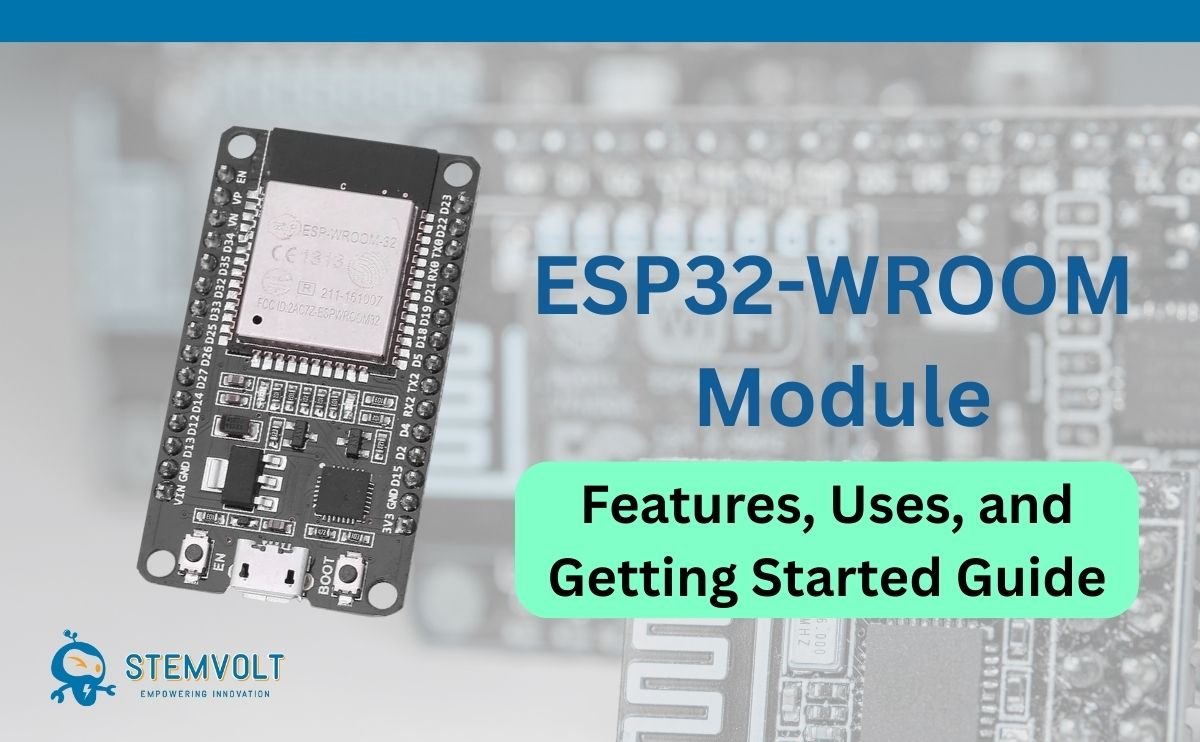
The esp wroom 32 is a powerful, generic Wi-Fi + BT + BLE MCU module that targets a wide variety of applications. At its heart is the ESP32-D0WDQ6 chip. The “WROOM” designation refers to the integrated module that includes the chip, flash memory, a precision crystal oscillator, and an onboard PCB antenna—all shielded under a metal can to reduce EMI (Electromagnetic Interference).
Engineered by esp32 espressif, this module is designed to be scalable and adaptive. It features two CPU cores that can be individually controlled, and the clock frequency is adjustable from 80 MHz to 240 MHz. This means you can run a high-speed web server on one core while handling time-critical sensor data on the second core, a feat that single-core microcontrollers struggle to achieve without complex RTOS (Real-Time Operating System) management.
Technical Specifications and Architecture
To appreciate the esp32 module, we need to look under the hood at its engineering specs. It is not just a microcontroller; it is a System-on-Chip (SoC).
Dual-Core Power: Most variants feature the Xtensa® Dual-Core 32-bit LX6 microprocessor.
Connectivity: Integrated 802.11 b/g/n Wi-Fi and Bluetooth v4.2 BR/EDR and BLE.
Rich Peripherals: It includes capacitive touch sensors, Hall sensors, SD card interface, Ethernet, high-speed SPI, UART, I2S, and I2C.
Ultra-Low Power: It features a specialized ULP (Ultra-Low Power) co-processor, allowing it to monitor sensors while the main cores are in deep sleep, consuming as little as 10µA.
For developers, this means the module can handle everything from simple LED blinking to complex cryptographic processing for secure IoT cloud connections.
Why Choose ESP32 for Your Projects?
When comparing the esp32 module price to its performance, the value proposition is unbeatable for Indian students and startups.
Versatility: It supports both Classic Bluetooth (for audio/legacy data) and Bluetooth Low Energy (for battery-operated sensors).
Abundant GPIOs: With more pins than the ESP8266, you can connect more sensors, motor drivers, and displays without needing multiplexers.
Large Community Support: Since it is compatible with the Arduino IDE, MicroPython, and ESP-IDF, finding libraries and troubleshooting help online is incredibly easy.
Hardware Acceleration: It has built-in hardware accelerators for AES, SHA-2, RSA, and ECC, making your IoT devices secure by design.
Getting Started: Development Boards
While the bare module is great for custom PCB designs, beginners should start with development boards. These boards break out the pins to a breadboard-friendly format and include a USB-to-Serial converter (like the CP2102) and a voltage regulator.
If you are just starting, the choice usually comes down to the number of pins you need. At StemVolt, we recommend the following for stability and ease of use:
For standard projects: 30-Pin ESP-32 Development Board (Type-C)
For complex projects requiring more I/O: 38-Pin ESP-32 Development Board (Type-C)
Using these boards ensures you don’t have to worry about the intricate power sequencing required by the bare SoC.
Practical Use Cases in India
The applications for the esp32 espressif ecosystem are endless. Here are some real-world projects we see our customers building:
1. Smart Agriculture
Farmers and students are using the ESP32 to monitor soil moisture, temperature, and humidity. Data is sent over Wi-Fi to a central dashboard, allowing for automated irrigation control.
2. Home Automation
Because of its BLE and Wi-Fi capabilities, the ESP32 is the perfect hub for smart lights and fans. It can bridge a phone’s Bluetooth signal to a local Wi-Fi network for remote access.
3. Voice Controlled Systems
While the ESP32 can handle basic audio, many makers pair it with specialized modules. For instance, combining an ESP32 with the AI-Thinker VC-02 Voice Recognition Module allows for offline voice-activated robotics.
Essential Components & Ecosystem for ESP32
To build a complete system, you will need more than just the module. Explore these categories to round out your kit:
Explore more boards: Full ESP Boards Category
Check out: BLE Nano 4.2 Development Board for ultra-compact BLE needs.
Powering your project: Always ensure you have a stable 5V or 3.3V power source, as Wi-Fi chips can draw significant current spikes during transmission.
Beginner Tips for ESP32 Success
Check Your Power Source: The ESP32 can draw up to 250mA during Wi-Fi bursts. If your board keeps resetting, your USB port or power supply might not be providing enough current.
Understand 3.3V Logic: Unlike the older Arduino Uno which uses 5V, the ESP32 is a 3.3V device. Connecting a 5V sensor directly to the GPIO pins can permanently damage the module. Use logic level shifters or simple resistors for voltage dividing.
Boot/EN Buttons: If your code isn’t uploading, you might need to hold the ‘BOOT’ button on the dev board while the IDE says “Connecting…”.
Install the Right Drivers: Most StemVolt boards use the CP2102 or CH340 chip. Ensure you have the corresponding drivers installed on your PC to recognize the COM port.
Dual-Core Advantage: Start with the Arduino IDE, but eventually explore “FreeRTOS” to learn how to run tasks in parallel on both cores.
Conclusion
The esp32 module is more than just a component; it is an entry point into professional-grade engineering. Its combination of dual-core processing, wireless versatility, and low power consumption makes it the ideal choice for any modern electronics project. By understanding the fundamentals of the esp wroom 32, students and developers in India can bridge the gap between local hardware and global cloud networks.
At StemVolt, we are committed to providing high-quality espressif esp32 boards and modules at the best esp32 module price to fuel your innovation. Whether you are building your first weather station or a complex robotics platform, the ESP32 is a reliable partner in your journey.