












DC Motor for Robotics and DIY Projects – Complete Guide

Introduction
If you’ve ever watched a small robot scuttle across a floor, a drone hover steadily in the air, or a DIY smart fan rotate on a hot afternoon, you’ve witnessed the work of a dc motor. In the world of electronics and STEM learning, the DC motor is perhaps the most fundamental actuator. It bridges the gap between digital code and physical motion, converting electrical energy into mechanical torque.
For students and makers in India, understanding the nuances of motors is the first step toward building successful engineering projects. Whether you are building a simple science fair model or a complex warehouse automation robot, choosing the right motor—be it a high-speed brushless dc motor or a high-torque 12v dc motor—can make or break your design. In this guide, we will dive deep into the mechanics, types, and control strategies for DC motors to help you make informed decisions for your next StemVolt-powered creation.
Construction of DC Motor: What’s Inside?
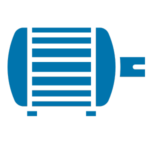
To use a motor effectively, you need to understand how it’s built. The construction of dc motor units generally involves two primary parts: the Stator (the stationary part) and the Rotor or Armature (the rotating part).
In a standard brushed motor, the stator consists of permanent magnets that create a constant magnetic field. Inside this field sits the rotor, which is essentially a coil of wire. When electricity passes through this coil, it generates its own magnetic field.
The “magic” happens at the Commutator and Brushes. These components ensure that the direction of the current in the coil flips at just the right moment, keeping the magnetic forces pushing the rotor in a single direction. While this design is simple and cost-effective, the physical friction of the brushes is why you might see small sparks or hear electrical noise during operation.
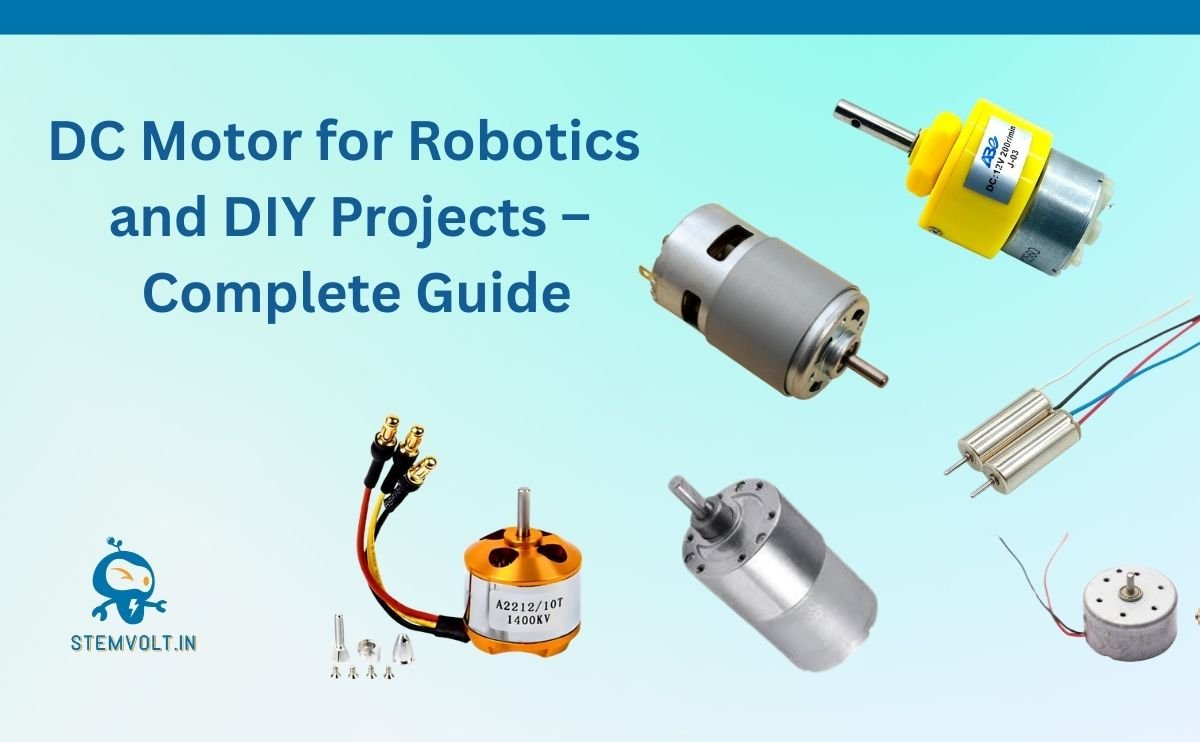
Exploring Different Types of DC Motor
In the Indian maker ecosystem, not all motors are created equal. Depending on your project’s needs—speed, torque, or precision—you will likely choose one of the following:
1. Brushed DC Motors
These are the most common motors for beginners. They are easy to drive; just connect them to a battery, and they spin.
-
Mini DC Motor: Ideal for small fans or vibration alerts. Check out this 3V-6V DC Motor (22mm) for lightweight projects.
-
12V DC Motor: The workhorse of mid-sized robotics.
2. Geared DC Motors
A motor by itself often spins too fast and has very little “pushing power” (torque). Gear motors attach a gearbox to the output shaft to reduce speed and increase torque.
-
For mobile robots, a 12V 100RPM Geared Motor provides the perfect balance for navigating flat surfaces.
-
For heavy-duty lifting or stair-climbing, the 12V 300 RPM Johnson Geared Motor is a legendary choice among Indian engineering students for its reliability.
3. Brushless DC Motor (BLDC)
BLDCs eliminate the brushes, using electronic controllers to switch the magnetic fields. These are significantly more efficient, reach higher speeds, and last longer. You’ll find these in high-end drones and electric vehicles.
4. Coreless Motors
Used in micro-drones, these motors lack an iron core in the rotor, making them incredibly light and responsive. The 816 Micro Coreless Drone Motor is a prime example of this technology in action.
DC Motor Speed Control and Driving Logic
You cannot simply connect a high-power 12 volt dc motor fan directly to an Arduino or Raspberry Pi. Microcontrollers provide logic, not the heavy current required by motors. This is where Motor Drivers come in.
The most common method for dc motor speed control is Pulse Width Modulation (PWM). Instead of lowering the voltage (which makes the motor weak), PWM rapidly switches the motor ON and OFF. The longer the “ON” duration (Duty Cycle), the faster the motor spins.
To implement this, you need a dedicated controller:
-
For small to medium projects: The 1203B PWM Speed Controller (6V-28V) is a plug-and-play solution.
-
For high-power applications: A 12V-40V 10A PWM Controller ensures your motor handles the load without overheating the circuitry.
Technical Integration: From Microcontrollers to Motion
In a professional robotics setup, the motor is part of a larger ecosystem. Here is how they typically interface:
-
The Brain: An Arduino or ESP32 sends a PWM signal.
-
The Driver: An L298N or L293D motor driver receives that signal and draws power from an external Li-ion battery to turn the motor.
-
The Feedback: To make a robot move a precise distance, engineers add Optical Encoders to the motor shaft. This allows the microcontroller to “count” the rotations.
-
Protection: Always use Flyback Diodes or capacitors across motor terminals to prevent voltage spikes from frying your sensitive development boards.
Practical Use Cases in the Modern World
-
Line Follower & Obstacle Avoidance Robots: Using basic mini dc motor units with wheels and IR sensors.
-
IoT Smart Blinds: Using a 12v dc motor to automate window curtains via a smartphone app.
-
Agriculture Drones: Utilizing high-speed brushless dc motor technology for stable flight and payload carrying.
-
Conveyor Systems: STEM students often use 12v 100rpm dc geared motor setups to simulate industrial assembly lines.
Sourcing the Right Parts at StemVolt
Finding a reliable 12v dc motor price that fits a student budget can be tough. At StemVolt, we curate components specifically for the Indian maker community.
-
Explore our full range: DC Motors Collection
-
Find the right gears: Geared Motors Category
-
Control your motion: Motor Drivers & Regulators
Essential Tips for Beginners
-
Don’t ignore Stall Current: When a motor is blocked from spinning, it draws its maximum current (Stall Current). Ensure your battery and driver can handle this, or you’ll smell smoke!
-
Check the Voltage: Running a mini dc motor at 12V when it’s rated for 3V will result in a very short-lived (but fast) motor.
-
Use Thick Wires: For high-torque motors, thin jumper wires can create resistance and heat up. Use proper gauge wires for power connections.
-
Decoupling Capacitors: Solder a small 0.1uF capacitor across the motor terminals to reduce “noise” that can interfere with your sensors.
-
Secure Your Mounting: A high speed dc motor creates vibrations. Use proper clamps or brackets to prevent your project from shaking itself apart.
Conclusion
The dc motor is the heartbeat of modern DIY robotics. From the simplicity of a 12 volt dc motor fan to the precision of a geared industrial actuator, these components allow us to turn code into physical reality. Understanding the balance between speed and torque, and mastering the art of PWM speed control, are essential skills for any budding engineer or hobbyist in India.
By choosing quality components and following sound engineering practices, you can build machines that are durable, efficient, and impressive. Whether you are prepping for a college project or building a prototype for a startup, the right motor is the first step toward success.