













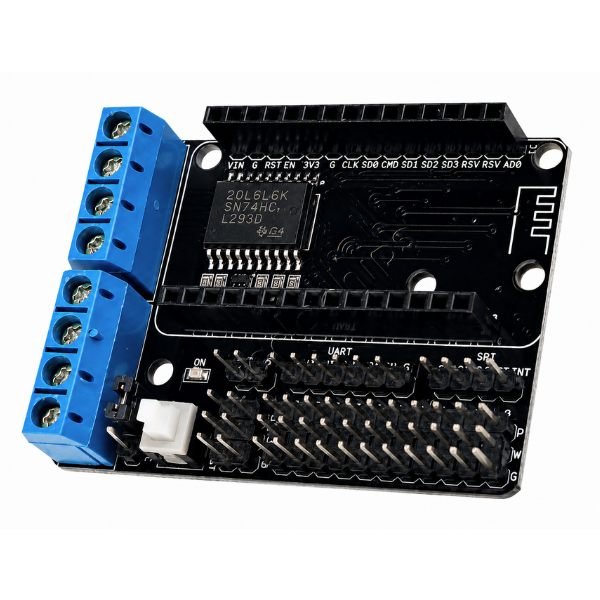
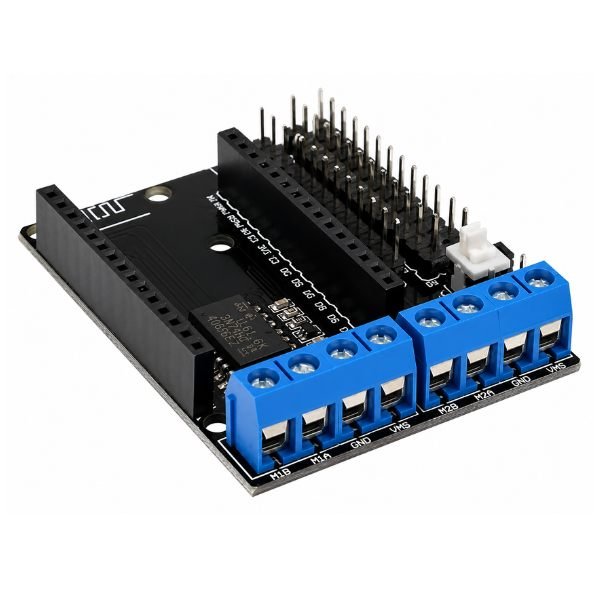
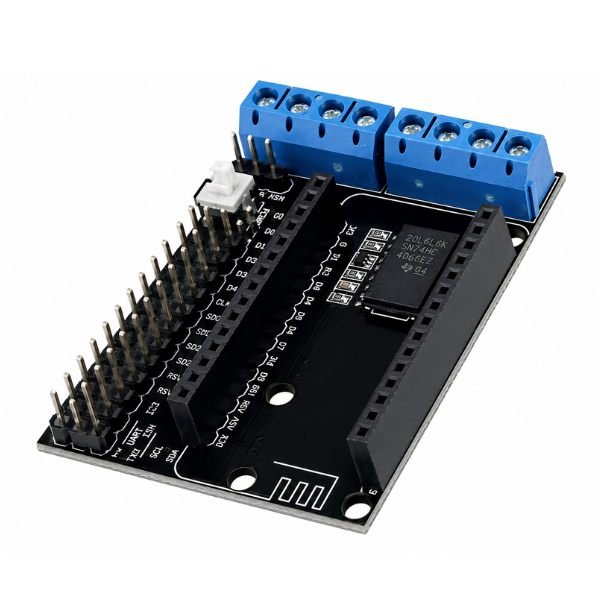
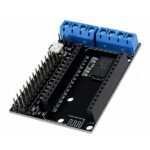



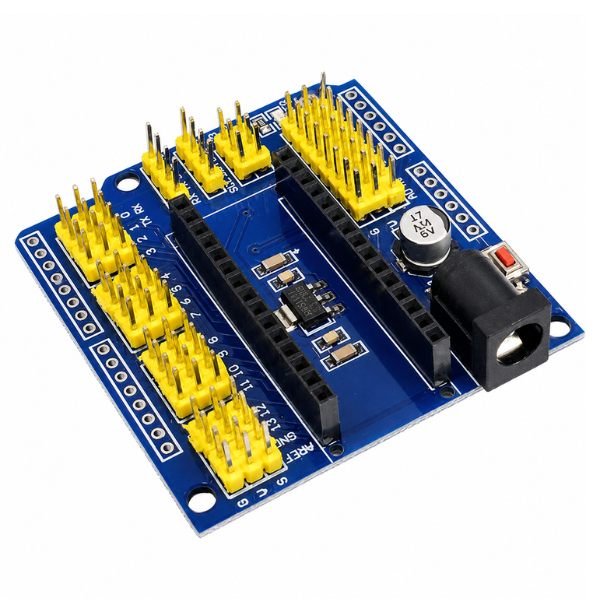
The L293D Motor Driver Board for ESP8266 NodeMCU is a plug-compatible motor driver expansion board that mounts directly onto a NodeMCU ESP8266 board and adds dual DC motor control through the L293D dual H-bridge driver IC. The board drives two DC motors independently, with each channel rated at 600mA continuous current and a motor supply range of 4.5V to 36V. GPIO pins on the ESP8266 connect directly to the L293D Motor Driver Board for ESP8266 input lines, with PWM support for variable motor speed control from the Arduino or NodeMCU firmware.
The nodemcu motor driver expansion design eliminates the external wiring normally required to connect a motor driver module to an ESP8266 — the board stacks directly onto the NodeMCU pin header. This makes the setup significantly more compact and breadboard-free, which is the primary advantage for 2WD and 4WD WiFi robot chassis builds where space inside the enclosure is limited. One practical trade-off: the L293D IC has a voltage drop of approximately 2V across each H-bridge transistor pair at full load. A motor rated at 6V will only see around 4V at the output terminals when running at full current from a 6V supply — factor this into motor selection for torque-sensitive builds.
The dual H-bridge driver topology is that it allows both forward and reverse direction control on each motor channel simultaneously using two GPIO lines per motor — direction is set by the HIGH/LOW state of each input pair, while PWM on the enable pin adjusts speed. The NodeMCU Motor Driver Expansion Board is widely used in Indian college robotics workshops for WiFi-controlled 2WD robots and IoT vehicle builds. Available from StemVolt, this unit is suitable for engineers working on WiFi motor control applications and practical robotics electronics projects.
Related Product:
-
Checkout the Motor Drivers and Regulators
Features:
- L293D dual H-bridge IC drives two DC motors independently and simultaneously
- 600mA per channel continuous current rating suits standard hobby DC motors
- Motor voltage 4.5V to 36V supports wide range of DC motor types
- Plugs directly onto NodeMCU header — no breadboard or jumper wires needed
- PWM enable pin allows variable speed control from ESP8266 firmware directly
Technical Specifications:
| Specification | Details |
|---|---|
| Driver IC | L293D |
| Motor Channels | 2 DC Motors |
| Drive Type | Dual High-Power H-Bridge Driver |
| Motor Voltage | Up to 12 V |
| Voltage Range | 4.5 V – 36 V |
| Current Capacity | 600 mA per Channel |
| Weight | 20 gm |
| Control Interface | GPIO (PWM Supported) |
| Compatibility | ESP8266 NodeMCU |
Applications:
- L293D Motor Driver Board used for WiFi controlled 2WD robot chassis
- College robotics project uses nodemcu motor driver for ESP8266 car build
- IoT vehicle project uses dual H-bridge driver for bidirectional motor control
- Smart conveyor uses NodeMCU Motor Driver Expansion Board for PWM speed control
- Engineering lab uses L293D Motor Driver Board for ESP8266 motor demo
Package Includes:
- 1 × L293D Motor Driver Board for ESP8266 NodeMCU

Nupur Chug –
L293D motor driver controls two DC motors independently and works perfectly with small robot motors and DIY automation projects
Vaibhav Suryavanshi –
No disappointment at all
Manjeet Chitale –
Foam protected packaging
Raghav Bansode –
Received this L293D Motor Driver Board with tracked delivery and foam protected packing, product quality was excellent and customer support helped promptly.
Arvind Khatri –
Useful motor driver board for NodeMCU applications, providing reliable motor control and easy integration with robotics projects
Purna Jha –
Best purchase ever
Ileana Gomes –
Bought from the best sensor store in India for a DIY robot project, motor control performance was stable and checkout process was very simple.
Devansh Rajawat –
Tracked delivery received