














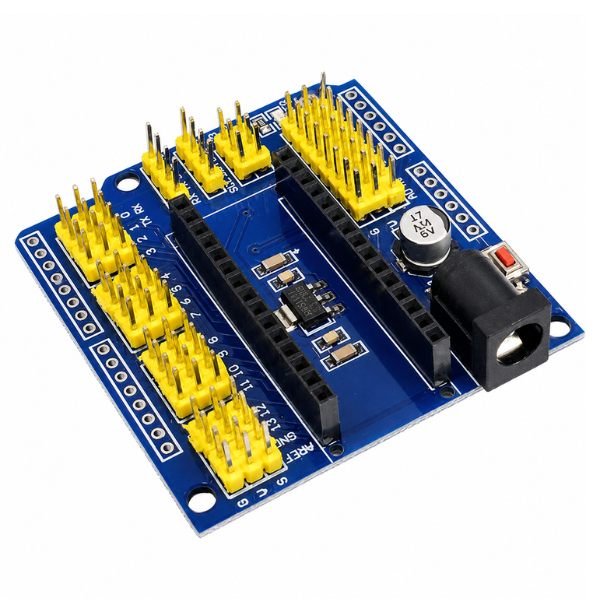
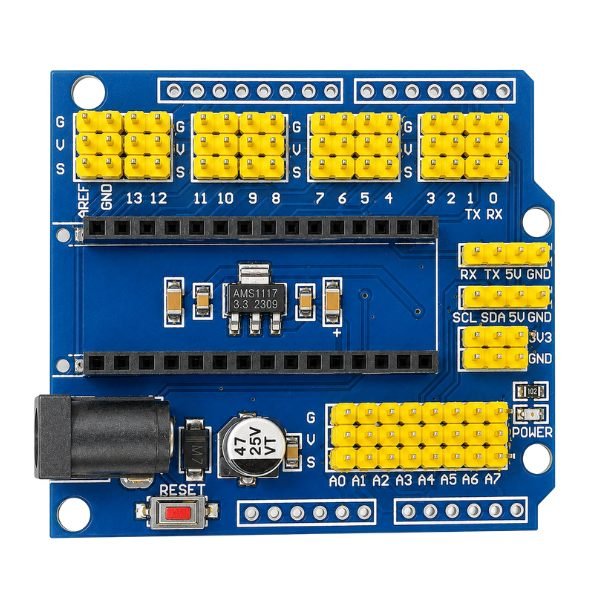
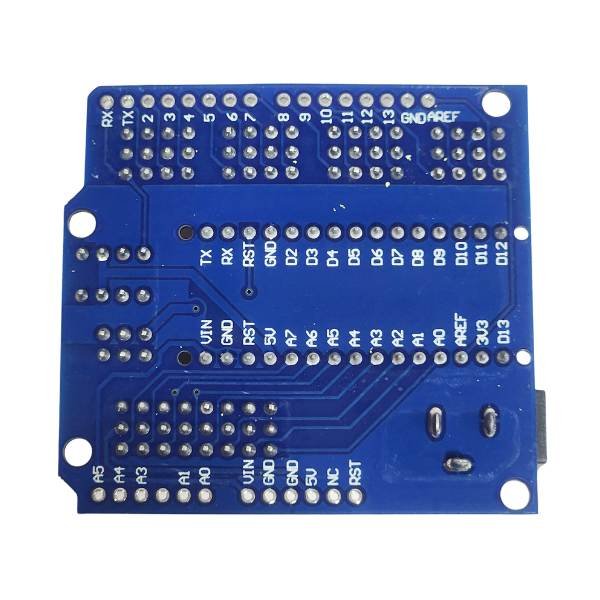
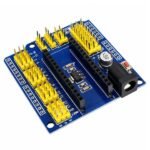
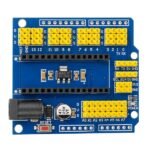
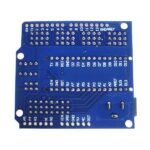



The Nano 328P Expansion Adapter Board with IO Shield is a purpose-built expansion board for Arduino Nano v2.x and v3.x (ATmega168 or ATmega328P) that converts the Nano’s compact dual-row pinout into 14 servo-type digital pin headers, 8 analog pin headers, 6 PWM outputs, I2C expansion pins, an AREF output, and both 3.3V and 5V regulated output rails on separate accessible headers. The arduino nano io shield seats the Nano module in a central ZIF-style or fixed socket and exposes every pin in a standard VCC-GND-Signal arrangement for direct sensor and actuator connection without any breadboard.
The nano expansion adapter board is the most practical solution to the Arduino Nano’s breadboard space problem — the Nano’s 0.1-inch pitch dual-row pins span most of a standard breadboard width, leaving almost no rail space for sensor wiring on either side. This nano 328p shield mounts the Nano above the expansion PCB and brings all connections out to labelled 3-pin servo headers that accept standard Dupont cables and sensor module connectors directly. The 3.3V and 5V outputs on this board draw their current from the Nano’s onboard regulators. The Nano 3.3V pin is limited to 50mA — avoid connecting multiple 3.3V sensors simultaneously if total current draw exceeds this limit.
The non-obvious advantage of the dual-voltage output (both 3.3V and 5V simultaneously) is that mixed-voltage sensor builds — combining 5V ultrasonic modules with 3.3V IMU sensors on the same Nano sketch — can be wired to the correct power rail directly from the expansion headers without external LDOs. The arduino nano adapter board is IOT labs for compact sensor builds, servo robot projects, and quick breadboard-free prototyping. Available from StemVolt, this unit is suitable for engineers working on Arduino Nano sensor interfacing and practical compact electronics projects.
-
Explore The LGT-RF-Nano V2.0 Wireless Module
Features:
- All 14 digital pins broken out as servo-type 3-pin VCC GND Signal
- Both 3.3V and 5V rails available for mixed-voltage sensor builds
- 8 analog headers with power and GND on every individual connector
- I2C expansion pins allow direct sensor connection without extra wiring
- AREF output enables external reference voltage for precision ADC readings
Technical Specifications:
| Specification | Details |
|---|---|
| Compatible Board | Arduino Nano v2.x and v3.x (ATmega168 / ATmega328P) |
| Input Voltage | 3.3 V – 5 V |
| Output Voltage | 3.3 V and 5 V |
| Digital I/O Pins | 14 Servo-Type Pins |
| Analog Pins | 8 Pins with Power and GND |
| PWM Pins | 6 PWM Output Pins |
| Communication Interfaces | I²C, UART via Nano |
Applications:
- Nano 328P Expansion Adapter Board used for compact servo robot arm build
- IoT project uses nano 328p expansion board for I2C display wiring
- Mixed voltage sensor build uses nano shield for 3.3V and 5V modules
- School STEM lab uses nano sensor shield for breadboard-free sensor demo
- Prototyping session uses Arduino nano shield for fast Dupont cable build
Package Includes:
-
1 × Nano 328P Expansion Adapter Board with IO Shield

Kamal Chaturvedi –
Multiple power input options provide flexibility for different project requirements and college-level electronics applications
Rajesh Bansal –
Highly recommended adapter
Nidhi Maheshwari –
Perfect for nano projects
Ankit Paliwal –
Received this Nano 328P expansion adapter board in 3 days with secure packaging, setup was simple and support responsive, team helped with queries.
Vikas Solanki –
Trustworthy product quality
Saurav Mishra –
Servo-style connectors and integrated power rails make wiring easier and more organized for prototyping and development work