













Top 10 Arduino Projects for Beginners in 2026 | Easy DIY Robotics Ideas

Introduction
In 2026, the world of DIY electronics has evolved, but one thing remains constant: the arduino board is the heartbeat of innovation for makers. Whether you are a student in a classroom or an engineer prototyping a new automation system, the arduino microcontroller offers an accessible gateway into the world of embedded systems. Its versatility allows it to be used in everything from simple LED blinkers to complex industrial IoT nodes.
The reason the Arduino platform remains relevant today is its “low barrier to entry.” With a reasonably low arduino board price, anyone can start building. For students in India, learning Arduino isn’t just about playing with wires; it’s about developing logical thinking, understanding circuit design, and mastering the fundamentals of robotics. From building a basic robot kit to exploring advanced robotics kits for schools, the skills learned here are the building blocks of a career in modern technology. At StemVolt, we see these projects as the spark that turns a curious student into a capable innovator.
What is an Arduino Board and How Does it Work?
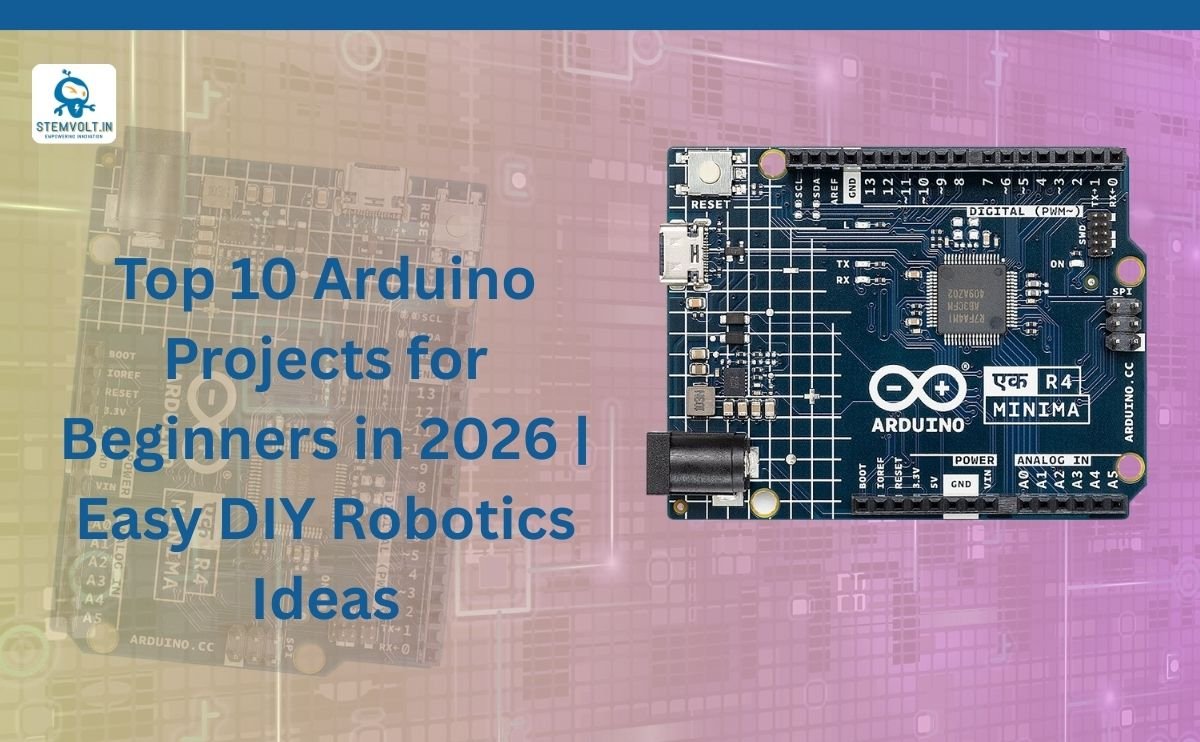
An arduino controller is essentially a development board based on an AVR or ARM microcontroller. Think of it as a small, simplified computer that can read inputs—such as light on a sensor, a finger on a button, or a Twitter message—and turn it into an output, like activating a motor or turning on an LED.
The magic lies in its hardware-software synergy. You write code (a “sketch”) in the Arduino IDE and upload it to the board via USB. The board then executes this code in a continuous loop. Unlike your laptop, which is designed for multitasking, an arduino uno board or an arduino nano is designed to do one thing exceptionally well: interact with the physical world in real-time.
Top 10 Arduino Projects for Beginners in 2026
If you are looking for robot kits for kids or starting your first engineering lab project, these ideas provide the perfect starting point:
-
Obstacle Avoiding Robot: Uses an ultrasonic sensor and a robot chassis to navigate.
-
Smart Irrigation System: Monitors soil moisture and activates a water pump.
-
Digital Thermometer: Using a DHT11 sensor and a 2.4 inch TFT LCD Touch Display Shield.
-
Gesture-Controlled Car: Controlled by hand movements using an accelerometer.
-
Home Automation Hub: Controlling lights via Bluetooth or Wi-Fi.
-
Automatic Hand Sanitizer: A simple IR sensor-based project.
-
RFID Door Lock: Enhance security using an RC522 RFID module.
-
Line Follower Robot: The classic entry-level arduino robot kit project.
-
Weather Station: Uploading local climate data to a web server.
-
Bluetooth Controlled Arm: A robotic arm controlled via a mobile app.
Technical Explanation: The Engineering Behind the Motion
To build any successful robot kit, you need to understand the relationship between the brain, the muscle, and the power.
-
The Brain: This is your arduino board. It processes data.
-
The Sensors: These act as the “eyes and ears.” They detect light, distance, or sound.
-
The Muscle: Motors cannot be powered directly by the Arduino pins. You must use motor drivers (like the L298N) to translate the Arduino’s logic signals into high-current power for the robot wheels.
-
Passives: Resistors are essential to protect LEDs and pull up/down signals to ensure the microcontroller doesn’t read “ghost” inputs.
When choosing your board, consider the form factor. An arduino nano is perfect for compact wearables, while an Arduino Leonardo R3 Compatible is excellent for projects that need to emulate a USB keyboard or mouse.
Choosing the Right Hardware: Arduino Price and Kits
Choosing the Right Hardware: Arduino Price and Kits
One of the most common questions we get at StemVolt is about the arduino cost. In India, the arduino board price varies depending on whether you choose an original board or a high-quality compatible version. For students on a budget, compatible boards offer the same functionality at a fraction of the cost, making it easier to build a complete arduino robot kit.
If you are looking for a more structured learning experience, especially for younger learners, lego robotics kits or specialized robotics kits for schools provide pre-designed parts that snap together. However, for those who want to understand the “soul” of the machine, building from scratch using a 2WD Aluminum Smart Robot Car Chassis Kit and individual 85mm x 38mm Robot Car Wheels is far more rewarding.
Practical Use Cases for Beginners
-
STEM Learning: Schools are integrating Arduino to teach physics and coding through tactile interaction.
-
Engineering Labs: Universities use Arduino for rapid prototyping of mechanical and electrical systems.
-
Automation Systems: Small-scale industries use Arduino-based controllers for conveyor belt monitoring or simple sorting tasks.
-
IoT Experiments: Developing smart sensors that communicate with cloud platforms for data logging.
Essential Components for Your Robotics Journey
To build a complete system, you need to look beyond just the microcontroller. Explore these categories at StemVolt to round out your inventory:
-
Check out: Arduino Leonardo R3 Compatible for advanced USB projects.
-
Explore more boards: Arduino Compatible Boards Category
-
Add a display: 2.4 inch TFT LCD Touch Display Shield
-
Build your base: Robot Chassis Kits
-
Get moving: Robot Wheels & Couplers
-
Accessories: Arduino Shields and Accessories
Beginner Tips for Arduino Success
-
heck Your Connections: 90% of “code errors” are actually loose wires on a breadboard.
-
Start Small: Don’t try to build a 4-legged walking robot on day one. Start by blinking an LED, then move to a button, then a sensor.
-
Mind the Power: If you are using motors, use an external battery (like a 9V or Li-ion) to power the motor driver. Never draw heavy current through the arduino controller itself.
-
Read the Documentation: Always check the pinout of your specific arduino board (e.g., Nano vs. Uno) as they may differ slightly in pin mapping.
-
Use Comments: When writing code, explain what each line does. Your “future self” will thank you when you revisit the project six months later.
-
Don’t Fear the Magic Smoke: If you burn a component, don’t worry. It’s part of the learning process. Just analyze why it happened so you don’t repeat it!
Conclusion
The journey into electronics and robotics is one of constant discovery. The arduino board is more than just a piece of green plastic; it is a tool that empowers you to solve problems and bring your imagination to life. From simple school assignments to professional automation, the versatility of the arduino microcontroller is unmatched in the hobbyist world.
By choosing the right robot kit and understanding the fundamentals of speed, torque, and logic, you are setting yourself up for success in the future of technology. At StemVolt, we are proud to support the Indian maker community with reliable parts, from the smallest resistors to the most advanced original Arduino boards. Start small, build often, and keep innovating!