






Choosing the Right Temperature Sensor & IoT Sensors for Beginners

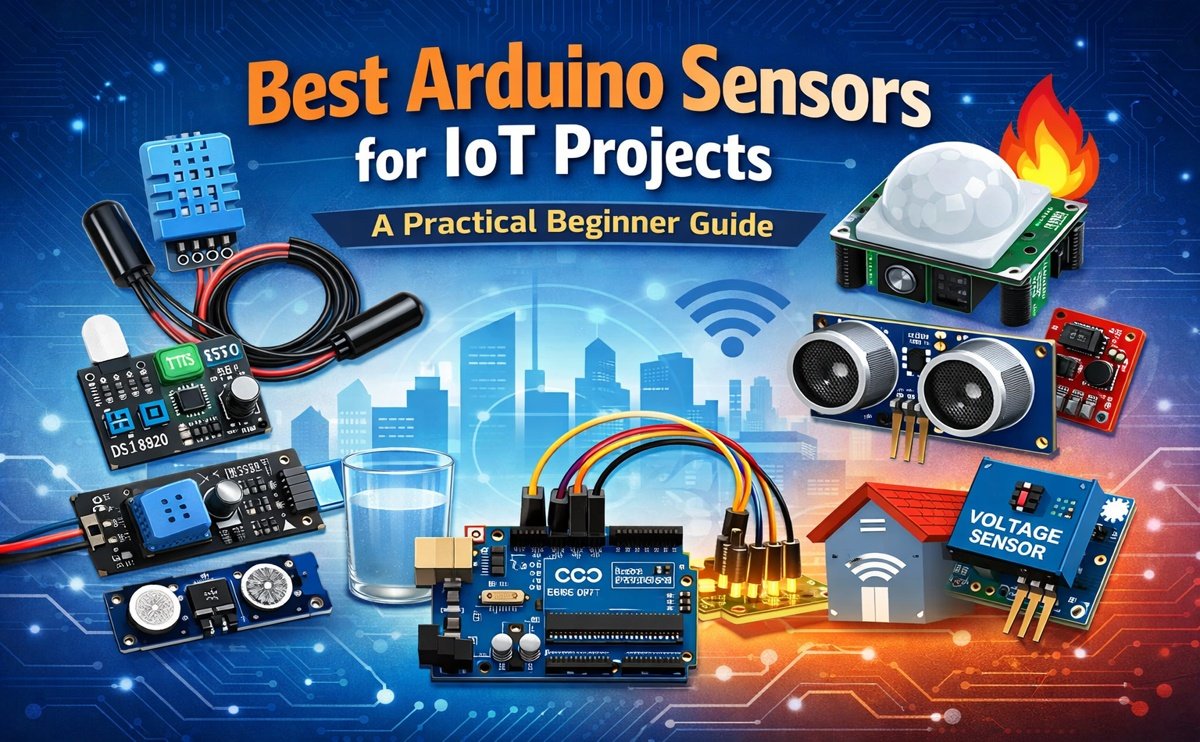
In today’s connected world, sensors are the backbone of every IoT (Internet of Things) project. Whether you’re building a smart home system, a weather monitoring device, or a robotics application, choosing the right temperature sensor, heat sensor, or voltage sensor is critical.
For beginners in electronics, sensors are often the first step into real-world hardware interaction. They allow microcontrollers like Arduino or ESP32 to sense environmental changes such as temperature, motion, light, or water quality. From a simple IR sensor module used in obstacle detection to a PIR sensor Arduino setup for motion sensing, each sensor plays a specific role in automation and smart systems.
Understanding how these sensors work, their pricing, and how to use them in projects not only improves your practical knowledge but also helps you make better buying decisions when searching for a reliable sensor shop near me or buying online.
What Are Sensors in IoT Projects?
Sensors are electronic components that detect physical changes in the environment and convert them into electrical signals. These signals are then processed by microcontrollers like Arduino, ESP32 boards, or Raspberry Pi.
Common types of sensors used in beginner IoT projects include:
- Temperature sensor – Measures ambient temperature
- Heat sensor – Detects excessive heat or fire conditions
- Voltage sensor – Monitors voltage levels in circuits
- Fire sensor – Detects flames or smoke
- Proximity switch – Detects nearby objects without contact
- IR sensor module – Used for obstacle detection
- Digital sensor – Provides output in digital form (HIGH/LOW)
For beginners, using a sensor kit is often the best way to start, as it includes multiple arduino sensors for experimentation.
How Do These Sensors Work?
Each sensor works based on a different principle depending on what it measures.
- A temperature and humidity sensor Arduino module (like DHT11/DHT22) uses internal sensing elements to measure atmospheric conditions.
- A TDS sensor Arduino measures water purity by checking electrical conductivity.
- An IR sensor module uses infrared light transmission and reflection to detect objects.
- A PIR sensor Arduino detects motion based on changes in infrared radiation from living beings.
- A voltage sensor uses a voltage divider circuit to safely measure higher voltages.
Some sensors use analog output, while others are digital sensors, making them easier for beginners to interface with microcontrollers.
Key Components Used with Sensors
To build a functional IoT system, sensors are combined with other essential electronic components:
- Microcontrollers – Arduino, ESP32 boards
- Resistors & Capacitors – For signal conditioning
- Sensor probe / probe sensor – For accurate environmental measurements
- Motor drivers – For controlling motors in automation
- Wireless modules – For communication
Wireless communication is especially important in IoT projects. Common options include:
- Bluetooth transmitter module – For short-range communication
- Zigbee wireless module – For mesh networks
- LoRa transmitter and receiver – For long-range, low-power applications
- Transmitter receiver module – For RF-based control systems
These components help sensors communicate data effectively in real-time systems.
Benefits of Using Sensors in Electronics Projects
Using sensors in your projects offers multiple advantages:
- Enables real-time monitoring of environmental conditions
- Helps automate systems like lighting, security, and irrigation
- Improves safety using fire sensor and heat sensor modules
- Makes projects interactive and intelligent
- Builds strong practical understanding for students and engineers
For students working on STEM projects, sensors provide hands-on learning that bridges theory with real-world applications.
Technical Explanation: How Sensor Systems Work Together
A typical IoT sensor system consists of three main stages:
- Sensing Layer – Sensors like temperature sensor, IR sensor, or vibration motion sensor collect data.
- Processing Layer – Microcontrollers (Arduino, ESP32 boards) process the data.
- Communication Layer – Wireless modules send data to other devices or cloud platforms.
For example, in a smart home system:
- A PIR sensor Arduino detects motion
- The microcontroller processes the signal
- A wireless module sends data to a mobile app
- A relay or motor driver activates lights or alarms
Additional components like biometric cables, connectors, and heat shrink sleeve are used to ensure safe and reliable connections.
Practical Use Cases of IoT Sensors
Sensors are used in a wide range of real-world and educational applications:
1. Robotics Projects
- Obstacle detection using IR sensors
- Line-following robots
- Autonomous navigation
2. IoT Experiments
- Smart weather stations using temperature and humidity sensors
- Water quality monitoring using TDS sensor Arduino
- Smart energy monitoring using voltage sensors
3. Home Automation
- Motion-based lighting using PIR sensors
- Fire detection systems using heat and fire sensors
4. STEM Learning & Labs
- School and college electronics experiments
- Engineering prototypes
- DIY innovation projects
These applications help students and developers understand how electronics integrates with real-world problem-solving.
Explore Sensors and Modules at StemVolt
If you’re planning to build your own IoT project, choosing the right components is important.
Check out this useful module for wireless control:
https://stemvolt.in/product/2-channel-rf-wireless-relay-remote-control-transmitter-and-receiver-module/
Explore more sensor categories:
- https://stemvolt.in/product-category/sensors/biomedical-sensors/
- https://stemvolt.in/product-category/sensors/current-and-voltage-sensors/
- https://stemvolt.in/product-category/sensors/ir-ultrasonic-and-proximity-sensors/
- https://stemvolt.in/product-category/sensors/force-flex-and-load-sensor/
These categories cover a wide range of sensors suitable for beginners as well as advanced users.
Beginner Tips for Working with Sensors
If you’re just starting with sensors, keep these practical tips in mind:
- Start with basic modules like IR sensor and temperature sensor before moving to complex ones.
- Always check the sensor price and specifications to ensure compatibility with your project.
- Use proper wiring and insulation like heat shrink sleeve to avoid short circuits.
- Prefer digital sensors for easier coding and integration.
- Test sensors individually before combining them in a project.
- Use reliable platforms like online stores instead of searching randomly for a “sensor shop near me”.
Conclusion
Sensors are the foundation of every IoT and automation project. From a simple temperature sensor to advanced modules like TDS sensor Arduino or proximity switch, each component plays a vital role in building intelligent systems.
For beginners, learning how to use sensors not only improves technical skills but also opens the door to real-world innovation in robotics, automation, and smart devices. By understanding how sensors work, how they connect with microcontrollers, and how to choose the right components based on sensor price and application, you can build efficient and reliable projects.
Whether you’re a student, hobbyist, or engineer, investing time in learning sensors will significantly enhance your electronics journey—and platforms like StemVolt make it easier to access quality components for every level of learning.