













Robotics Kits for Students in India from Stemvolt – Learn, Build, Innovate

The Future of Learning: Why Robotics is Essential for Indian Students
The landscape of education in India is shifting rapidly. We are moving away from rote memorization and heading toward a “learning by doing” philosophy. As an engineer, I’ve seen firsthand how a theoretical understanding of a circuit diagram differs from actually smelling the solder and seeing a motor spin for the first time. This is where robotics kits for schools and individual learners become game-changers.
Robotics is the perfect intersection of computer science, mechanical engineering, and electronics. For a student, building a robot isn’t just a weekend hobby; it is an introduction to logical thinking, troubleshooting, and spatial awareness. Whether you are a middle-schooler curious about “how things work” or a college student diving into automation, robotics provides a tangible way to see the results of your code and hardware design in the physical world. At StemVolt, we believe that providing the right tools early on bridges the gap between being a consumer of technology and becoming a creator of it.
Understanding Robotics Kits: More Than Just Toys
When people hear the term “robot kits for kids,” they often envision plastic wind-up toys. However, in the world of STEM (Science, Technology, Engineering, and Mathematics), a robotics kit is a sophisticated educational ecosystem. These kits are designed to scale with the learner’s ability.
A beginner might start with a diy robot kit that focuses on mechanical assembly and basic gear ratios, while an advanced learner might transition to an arduino robot kit that involves C++ programming and complex sensor integration. The core objective of these kits is to demystify technology. By breaking down a complex machine into its constituent parts—motors, controllers, and sensors—students lose their “fear of the machine” and gain the confidence to innovate.
Key Components of a Modern Robotics Kit
To understand how a robot functions, we must look at it through the lens of an engineer. Every functional robot, regardless of its size, generally consists of four main subsystems:
The Brain (Microcontroller): This is usually an Arduino, Raspberry Pi, or a proprietary controller. It processes input from sensors and sends commands to the actuators.
The Muscle (Actuators/Motors): These provide movement. Most kits use DC motors for wheels or Servo motors for precise limb movements.
The Senses (Sensors): Ultrasonic sensors for distance, IR sensors for line following, and DHT sensors for environmental data allow the robot to interact with its surroundings.
The Power House: This includes battery packs and voltage regulators that ensure the electronics receive a steady current without frying the delicate logic gates.
For those just starting, the 2WD DIY Robot Car Chassis Kit for STEM Learning is an excellent entry point that introduces these mechanical and electronic fundamentals.
The Role of Arduino in Robotics Education
If you are looking to move beyond simple “on/off” robots, the arduino robot kit is the gold standard. Arduino is an open-source electronics platform based on easy-to-use hardware and software. It is particularly popular in India because of its affordability and the massive community support available.
Using an Arduino allows a student to write code that makes decisions. For example, “If the ultrasonic sensor detects an obstacle closer than 20cm, stop the motors and turn left.” This logic is the basis of artificial intelligence and automated systems used in modern factories. Learning to interface an Arduino with a motor driver (like the L298N) is a foundational skill for any aspiring robotics engineer.
Technical Deep Dive: How a Robot “Thinks” and Moves
From an engineering perspective, a robot operates on a feedback loop known as the Sense-Think-Act cycle.
Sense: The robot gathers data. For instance, using a 10kOmega resistor in a voltage divider circuit with a photoresistor (LDR) allows the robot to “sense” light levels.
Think: The microcontroller reads the analog voltage. If the value drops below a certain threshold, the code triggers a response.
Act: The microcontroller sends a PWM (Pulse Width Modulation) signal to a motor driver.
Why use a motor driver? A microcontroller like an Arduino cannot provide enough current (amperage) to spin a motor directly; doing so would destroy the chip. The motor driver acts as a high-current switch, controlled by the “brain” to move the “muscles.” Understanding this isolation between logic and power is a crucial lesson in electronics design.
Choosing the Right Kit: From DIY to Solar Power
The variety of stem robotics kits available today can be overwhelming. The choice should depend on the student’s age and interest level:
For Younger Kids (Ages 8-12): Look for kits that focus on renewable energy and mechanical assembly. The 13-in-1 Solar Robot Kit for Kids is a fan favorite because it teaches the basics of solar power and gear mechanics without requiring a soldering iron or complex coding.
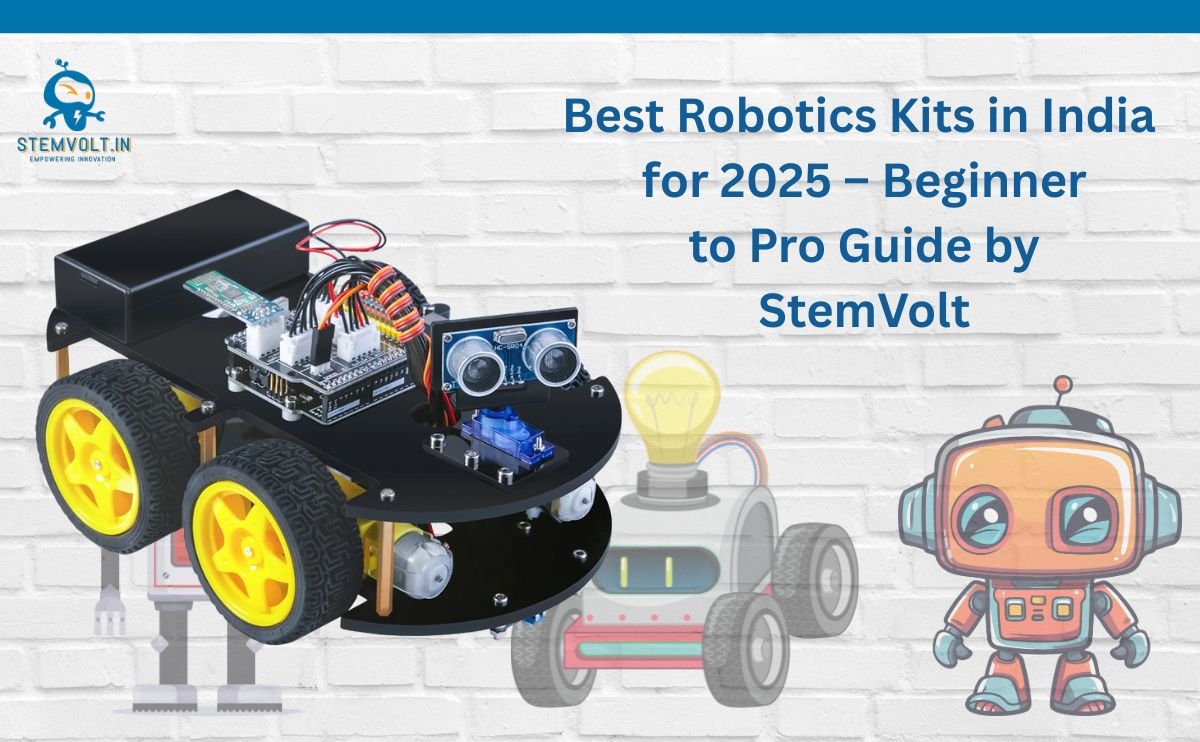
For Hobbyists and Makers: If you want to build a “smart” car, the chassis is your foundation. You can choose between a 2WD Smart Mini Round Robot Car Chassis for agility or a 4WD Double Layer Robot Car Chassis Kit for more power and space to add extra sensors and batteries.
For Schools: Lego robotics kits are often used for their modularity, but for a more deep-dive engineering experience, many Indian schools are now opting for open-source diy robot components that allow students to understand the circuitry at a granular level.
Practical Applications and Career Paths
Learning with a robot making kit isn’t just about making a toy move across the floor. The skills acquired are directly transferable to several high-demand industries:
Industrial Automation: The logic used in a line-following robot is the same logic used by AGVs (Automated Guided Vehicles) in Amazon warehouses.
Internet of Things (IoT): Adding a Wi-Fi module like the ESP8266 to a robot allows it to be controlled from anywhere in the world, a core concept of Industry 4.0.
Precision Agriculture: Small-scale robots are being developed in India to monitor soil health and automate pesticide spraying.
Mechatronics: A field that combines mechanical systems, electronics, and control theory—essential for the future of the automotive and aerospace sectors.
Beginner Tips for Success in Robotics
Starting your first diy robot project can be daunting. Here are a few tips from the engineering desk at StemVolt:
Check Your Grounding: Always ensure that your microcontroller and your motor power supply share a common ground (GND). Without this, your signals will be “noisy” and the robot won’t behave.
Start Simple: Don’t try to build a humanoid robot on day one. Start with a simple 2-wheel obstacle avoider. Success in small projects builds the stamina for larger ones.
Cable Management is Key: Loose wires are the leading cause of “ghost bugs” in robotics. Use zip ties or breadboard jumpers to keep your connections secure.
Understand Your Power Requirements: Motors draw a lot of current. Always use fresh batteries or a high-discharge Li-ion battery (with a proper BMS) for the best results.
Read the Datasheet: Before connecting a new sensor, check its operating voltage. Plugging a 3.3V sensor into a 5V pin is a quick way to end your project early!
Conclusion
The journey into robotics is one of the most rewarding paths a student can take. It transforms abstract mathematical concepts into physical reality and teaches resilience through debugging. Whether you are looking for robotics kits for schools to outfit a new lab or a robot kits for kids to gift a curious mind, the goal remains the same: fostering innovation.
At StemVolt, we are committed to providing the Indian maker community with high-quality, reliable components. By starting with a solid foundation—whether it’s a solar-powered explorer or a sophisticated 4WD Arduino-controlled vehicle—you are taking the first step toward an engineering career.
Explore our full range of tools and kits:
Explore more: Robotics Kits Category
Get started with: 13-in-1 Solar Robot Kit
Build your base: 4WD Double Layer Chassis Kit